

A Stellar Zombie S-Nova, Humanity's next Leap & Mercury Blinks - FEB. SkyGuide Update
From 100 million light-year explosions to the edge of the Moon: Your field guide for the month's most historic captures.

What other hobby allows you to capture the beauty of the universe from your own backyard? From witnessing the violent explosion of a star 100 million light-years away to observing the Moon, occulting planets, and comets visiting from deep space. DwarfVision was created to explore it all. We are a “collective launchpad,” a community dedicated to uncovering the universe’s breathtaking beauty through the power of DWARF and other smart telescopes. Our mission is simple: share knowledge, master the tricks, and witness the awe of the cosmos together.
Visit our SkyGuide Command Center on DwarfVision
Our Interactive SkyEvents & Observation Page is more than a list of what’s happening. It has evolved into a full-blown command center, packed with detailed field notes and the specific capture tips you need to master every target. We’ve also integrated breaking space news with specific target coordinates and community sighting alerts—all designed to get you on target and capturing data faster and more accurately than ever before.
Get weekly targets and processing secrets delivered straight to your inbox. Join the mission!
THE DEEP SKY EVENT: Supernova 2026acd
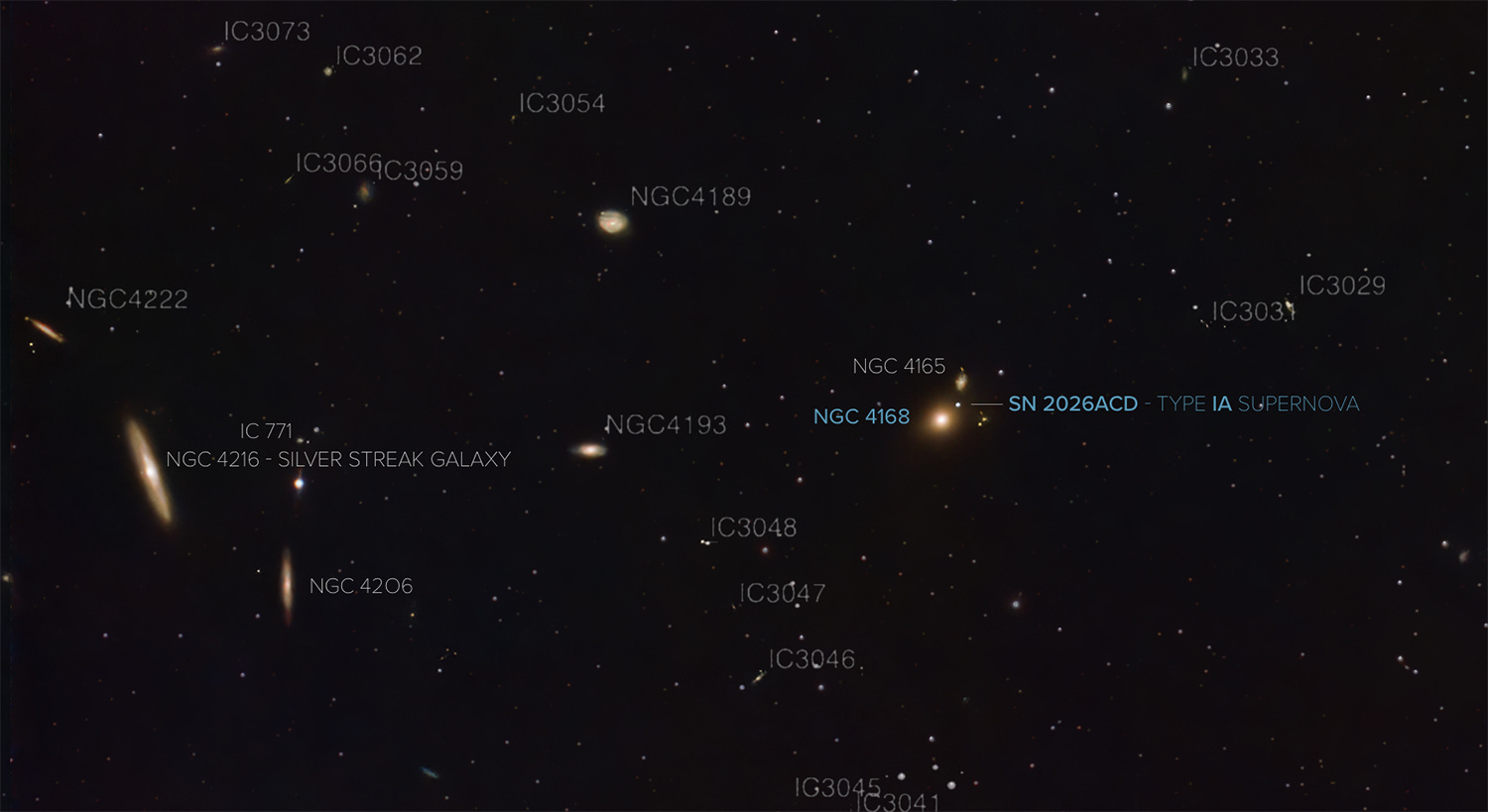
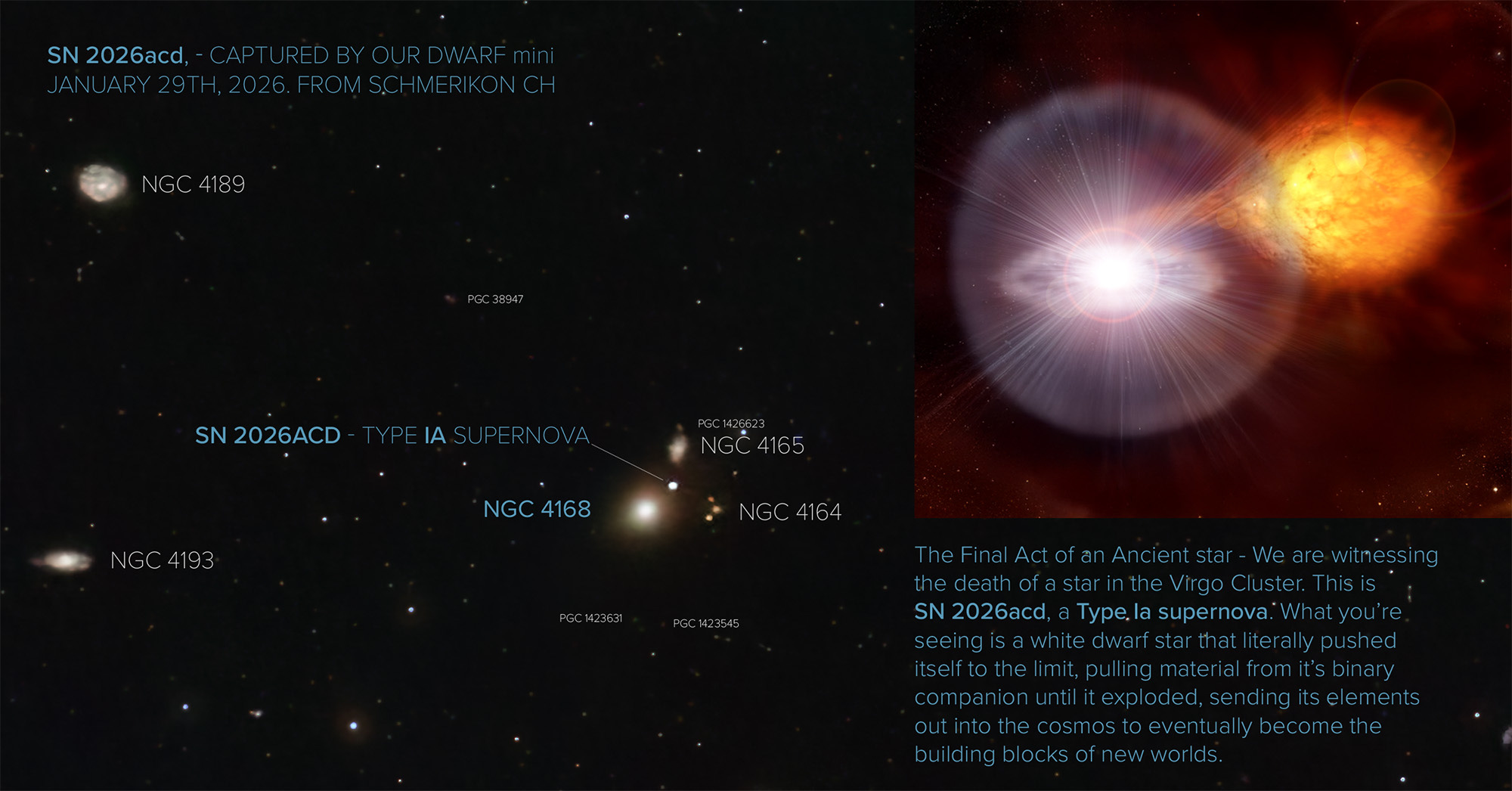
The biggest “SkyGuide” story in the deep sky right now is SN 2026acd. This isn’t just a star; it’s a catastrophic explosion in the elliptical galaxy NGC 4168, located in the heart of the Virgo Cluster.
The Science of the “Stellar Zombie”
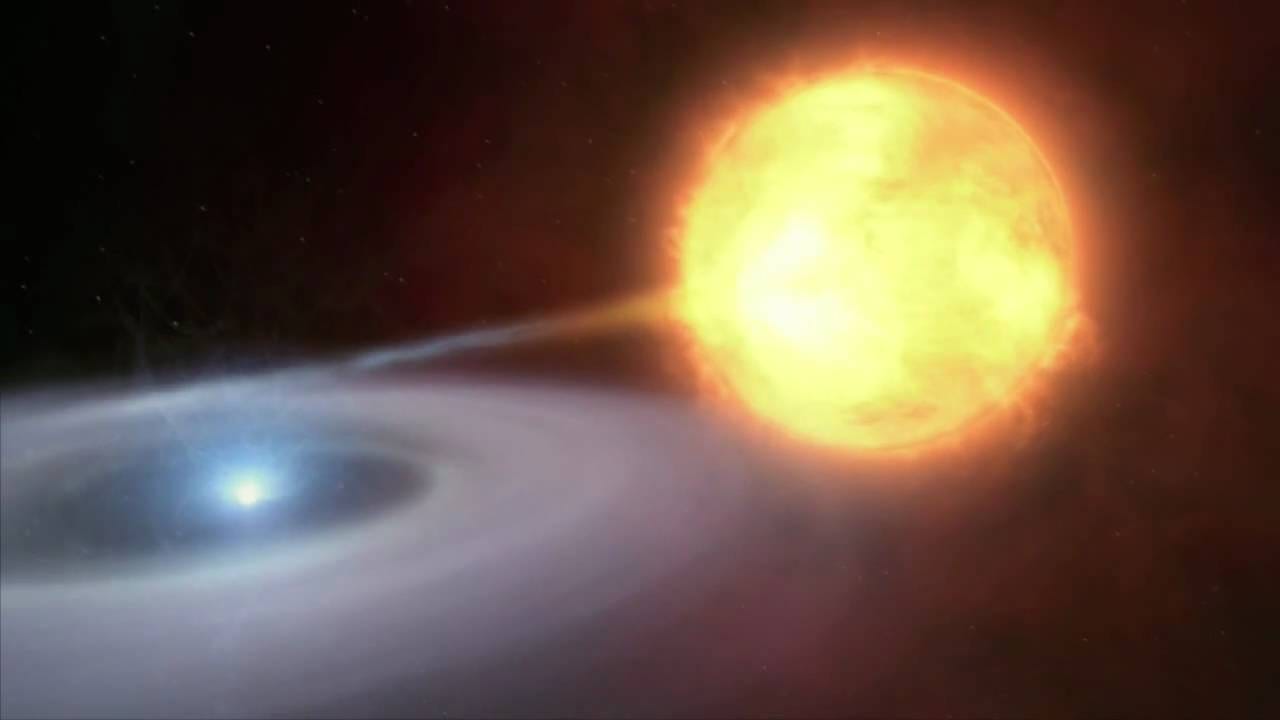
This is a Type Ia Supernova—and it’s currently on the rise. While most people call this the “death of a star,” it’s actually the destruction of a stellar corpse. It happens when a white dwarf—the dense, retired “zombie” remnant of a star like our Sun—siphons too much gas from a neighboring star until it hits a critical mass and triggers a runaway thermonuclear blast. Because these explosions always happen at the same “breaking point,” they shine with a predictable brightness that astronomers use as “Standard Candles” to measure the very scale of the universe. Recent community data indicate SN 2026acd is still brightening as it approaches its peak, making this the optimal time to start your integration.
Current SkyGuide Data:
Magnitude: 13.6 (and climbing!)—well within reach of our sensors.
Visibility: Late evening through early morning.
Location: Anchored near the core of NGC 4168 in Virgo.
Shooting the Explosion: A DwarfVision Pro-Tip
At magnitude 13.6, this isn’t about capturing a single frame. This is a deep-sky mission requiring a long-session stack of long exposures to pull raw data from 100 million light-years away.
How to capture it:
Since the host galaxy may not be in your scope’s internal library, you’ll need to use the Manual Coordinate Entry (the “+” icon next to the search field in the ATLAS).
Calibrate First: Make sure you’ve successfully calibrated on a visible part of the sky (like near Denebola in Leo) before you send the scope to these specific coordinates.
Enter the Coordinates: RA: 12h 13m 38.3s | Dec: +13° 03’ 25.3”
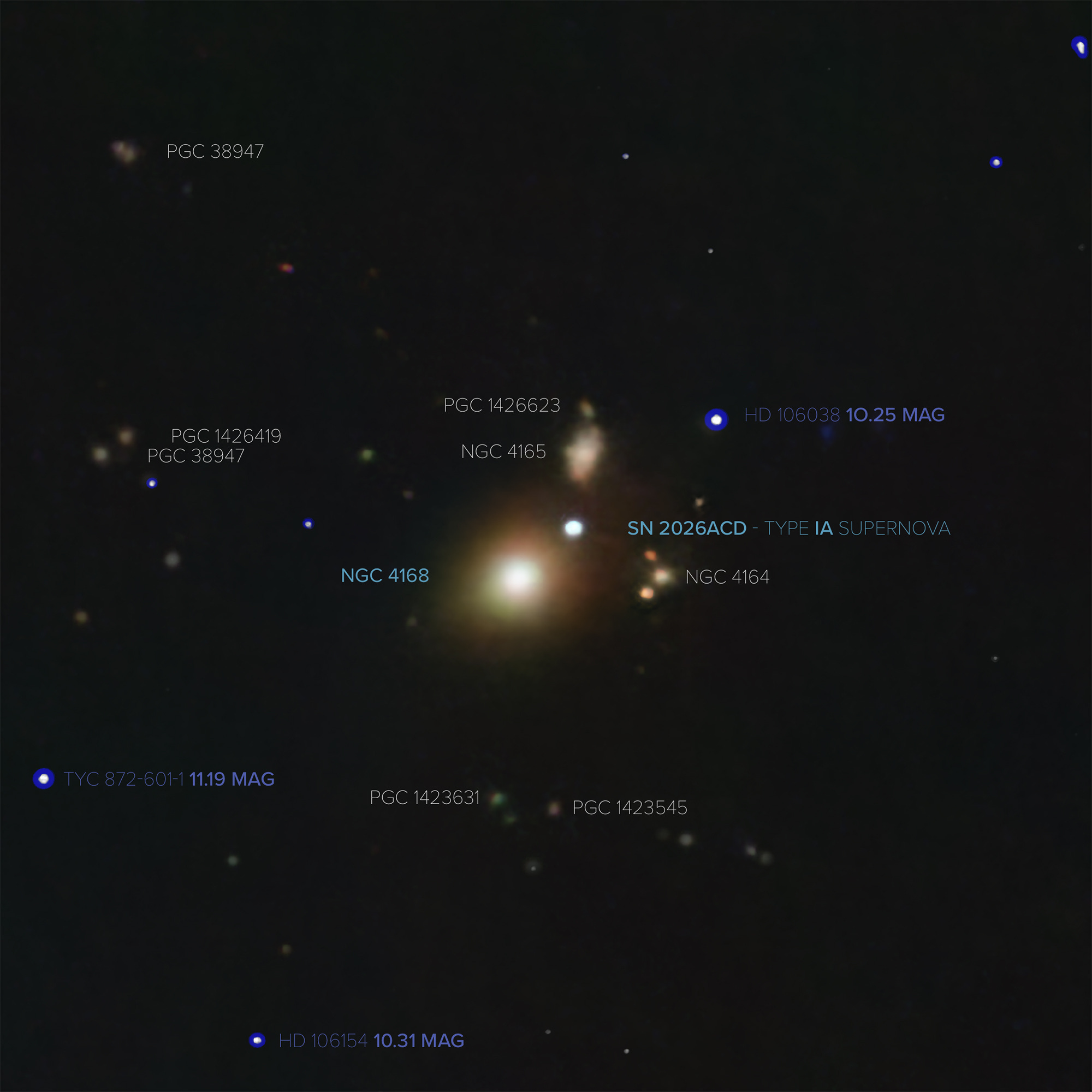
The Target: Once the scope slews, look for the tiny glow of NGC 4168. The supernova itself will not be visible without a few frames exposed and stacked.
Imaging Strategy:
If your sky is clear and your “seeing” (atmospheric stability) is steady, use these advanced settings to maximize your data.
Exposure (The Dwarf 3 / Mini Edge): * Dwarf 3: If your polar alignment is pinpoint, push for 60-second subs.
Dwarf Mini: This little powerhouse can handle up to 90-second subs in EQ mode.
Why? Longer subs capture more photons from the faint spiral arms and distant background galaxies that shorter exposures simply miss.
Stacking (The 4-Hour Goal): Don’t stop at an hour. Aim for 2 to 4 hours of total integration.
The Result: At 4 hours, the background noise drops significantly, and the “neighborhood” comes alive. You will likely pick up the nearby galaxy NGC 4165 and several other faint NGC and PGC galaxies in the same field of view.
The “Spotting” Trick: Once your 4-hour masterpiece is finished, look just south of the neighboring galaxy NGC 4165. The supernova will appear as a “new” bright bluish star that isn’t on any standard star charts. You are literally witnessing a star that blew up 100 million years ago, captured from your own backyard.
THE HISTORIC LEAP: Artemis II Launch (Target: Feb 8)
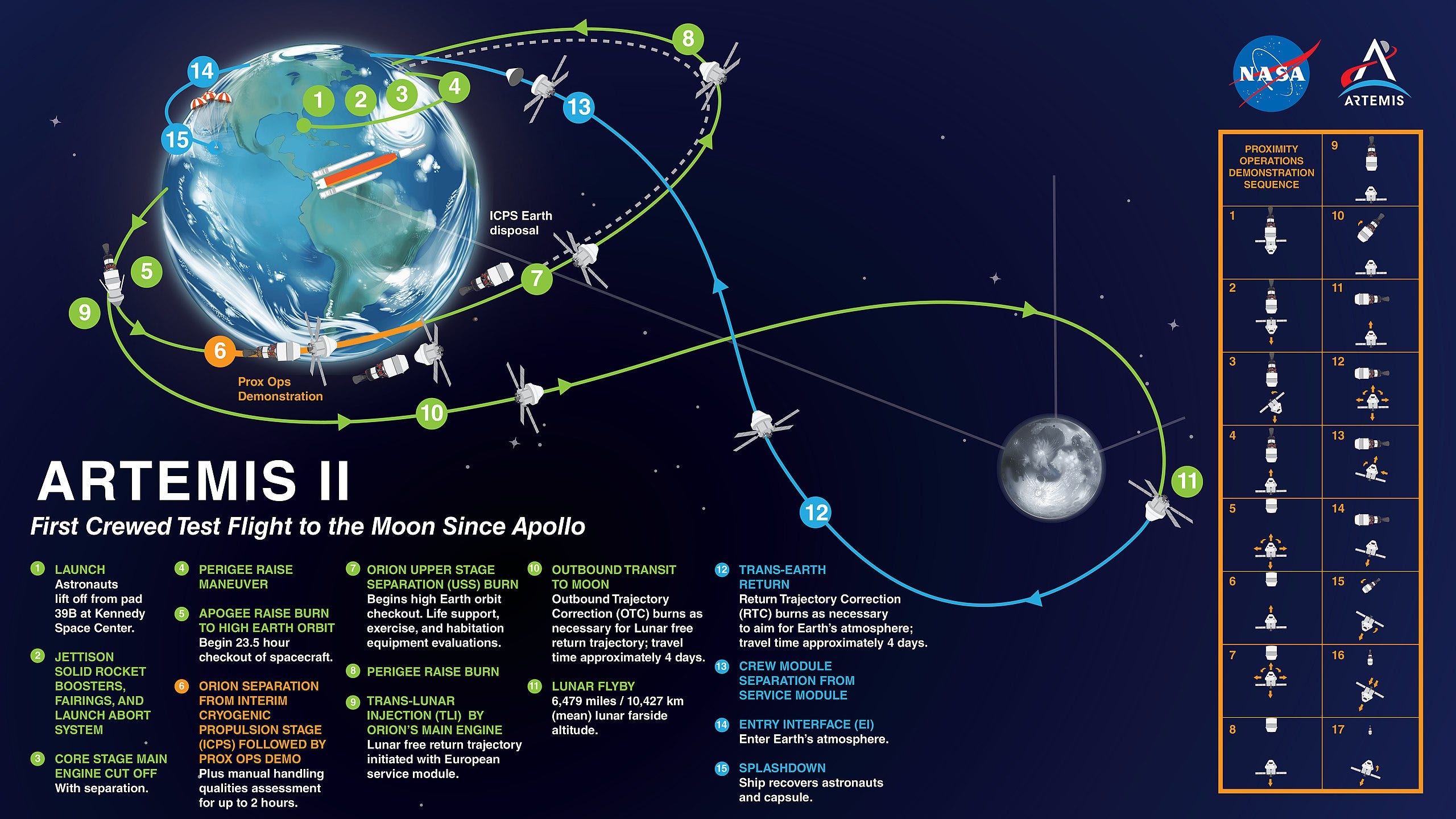
For the first time in over 50 years, humanity is returning to deep space. The Artemis II mission features a diverse crew of four: Commander Reid Wiseman, Pilot Victor Glover, and Mission Specialists Christina Koch and Jeremy Hansen. Launching atop the 322-foot Space Launch System (SLS) rocket, the crew will embark on a 10-day high-stakes flight test to prove the Orion spacecraft is ready for the next generation of lunar exploration.

THE JOURNEY: RECORD-BREAKING VELOCITY
After two initial high Earth orbits to verify life support and manual piloting, the crew will perform a Trans-Lunar Injection (TLI) burn. This maneuver sets Orion on a free-return trajectory, slingshotting the crew around the far side of the Moon. At its furthest point, the crew will reach approximately 4,600 miles (7,400 km) beyond the Moon. This path will take them roughly 250,000 miles from Earth, surpassing the distance record set by Apollo 13 and marking the farthest humans have ever ventured into space.
THE RETURN: CHASE THE STARS
As the crew completes their loop around the Moon, they will capture unprecedented high-resolution imagery of the lunar far side and the Earth-Moon system in a single frame. The mission concludes with a record-shattering reentry into Earth’s atmosphere at speeds of 25,000 mph (40,000 km/h). This final test of the Orion heat shield paves the way for the Artemis III landing mission, ensuring that humanity’s return to the Moon is not just a visit, but a permanent stay.
How to Capture the Mission (DwarfVision Exclusive)
Launch (FL/GA Focus): Unlike static cameras, the DWARF III can actively track the vehicle during ascent. Use Telephoto Video Mode and the AI Object Tracking feature. Draw a box around the brilliant engine plume once it clears the tower.
The Settings: For the sharpest view of the RS-25 engine bells, set Exposure to 1/500s or faster and Gain to 0. The SLS is essentially a rising sun; without these fast settings, you’ll likely see a white blob. However, you can also use “Auto” exposure if the plume doesn’t look too bright; this allows the exposure to adapt naturally as the rocket climbs and the atmospheric brightness diminishes. Use VIS filters if you are within 50 miles of the Cape.
Mid-Atlantic Streak (SC to NJ): By the time it reaches the Mid-Atlantic, the boosters will have separated. Use Wide Photo Mode for a 30-second Streak Shot to capture the glowing orange trajectory of the core stage.
In Orbit (Global): During the 24-hour HEO phase, Orion will move like a satellite. Use Astro Mode (1s Exp, 40 Gain) with a manual slew to mission-provided RA/Dec coordinates to catch solar array glints.
THE BLINK-AND-YOU’LL-MISS-IT TARGET: The Mercury Occultation (Feb 18)
A razor-thin Moon is going to pass directly over Mercury. This is the ultimate test of patience and preparation—you wait hours for a moment that finishes in an instant.
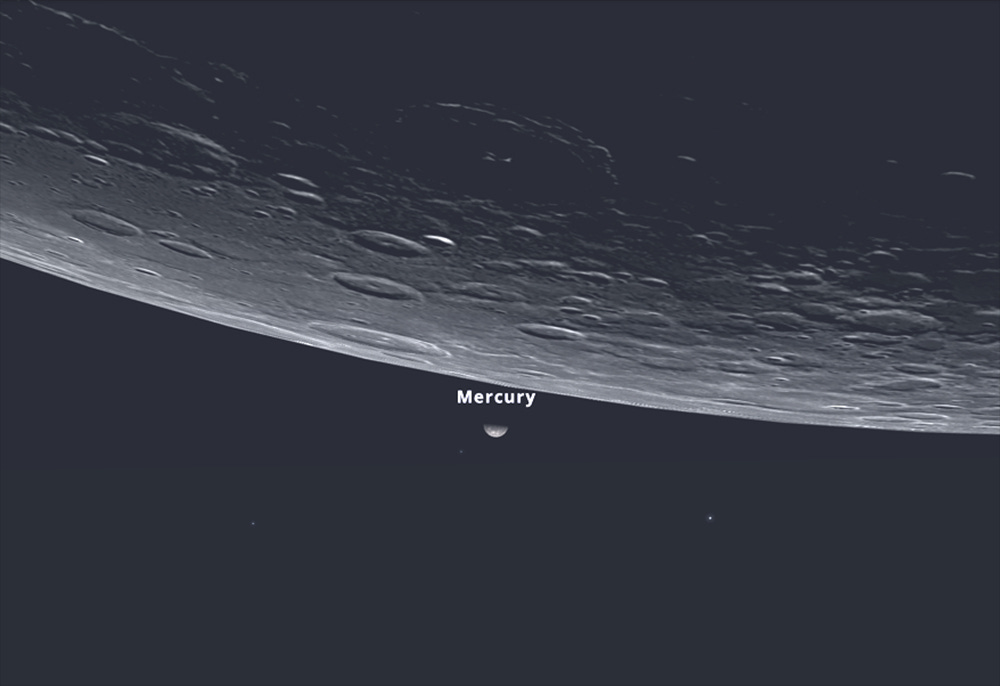
The Challenge: Mercury is a “point source.” It doesn’t fade behind the Moon; it pops out of existence. There is no second chance.
The “Occultation Corridor”: While a close conjunction is visible globally, the actual occultation (where the Moon hides Mercury) is restricted to a narrow path across Mexico, the Southern US, and the South Pacific. * Mexico: Prime viewing across the country. In Mexico City, the event begins around 18:25 CST, with Mercury reappearing about an hour later.
United States: The corridor clips the southern states. Residents in Houston, Phoenix, and Tucson are in the sweet spot. In Houston, expect the disappearance around 18:36 CST with the Moon low in the West (12° altitude).
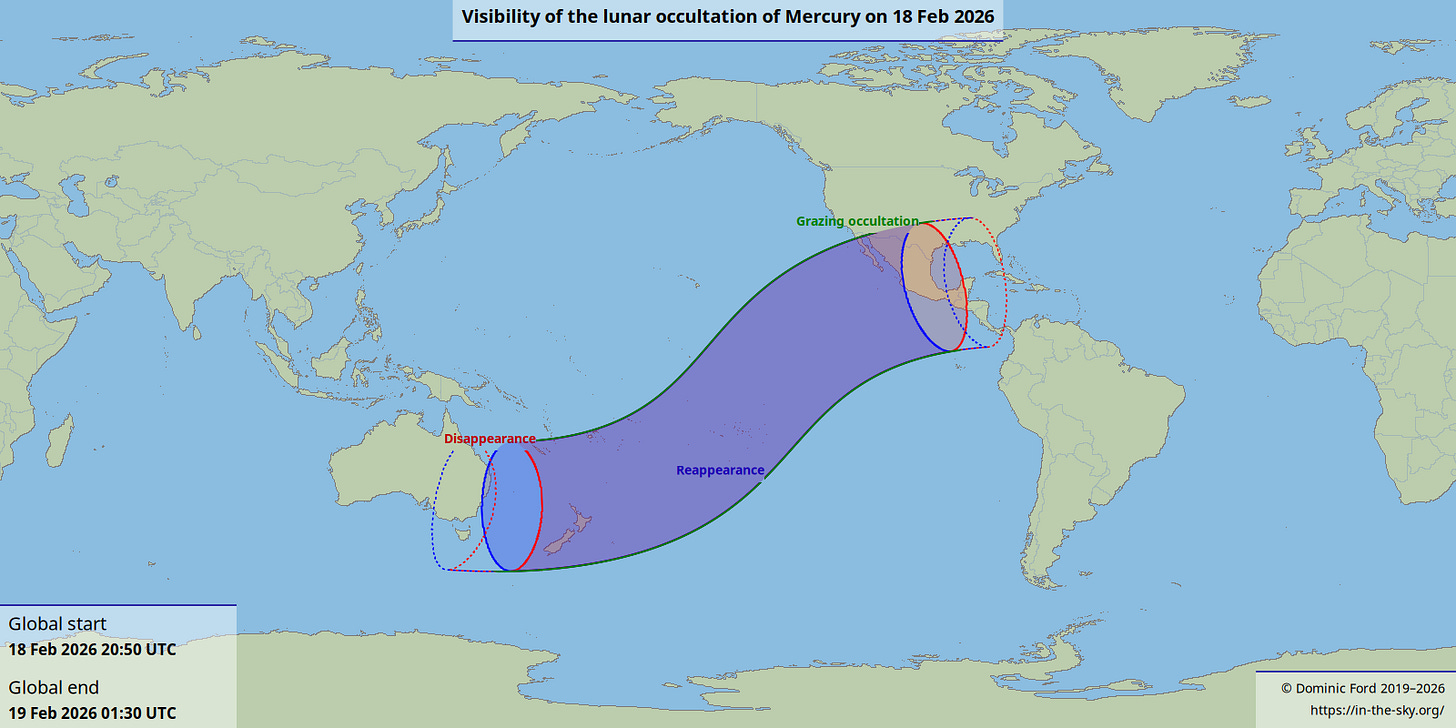
Map of the Occultation window for the Moon and Mercury on February 18th.
The Preparation: Success here isn’t just about settings; it’s about being lucky enough to have clear skies and perfectly prepared to hit “record” at the exact millisecond.
The Setting: Use your highest possible frame rate. Capturing the exact frame in which Mercury vanishes is a badge of honor for any videographer.
COMET CORNER & FEBRUARY HIGHLIGHTS
Comet C/2024 E1 (Wierzchos): SPECTACULAR for the South (Grus). Northerners: Late Feb evening sky (SW horizon) is the sweet spot. Settings: 10–15s exposures; 20m integration.
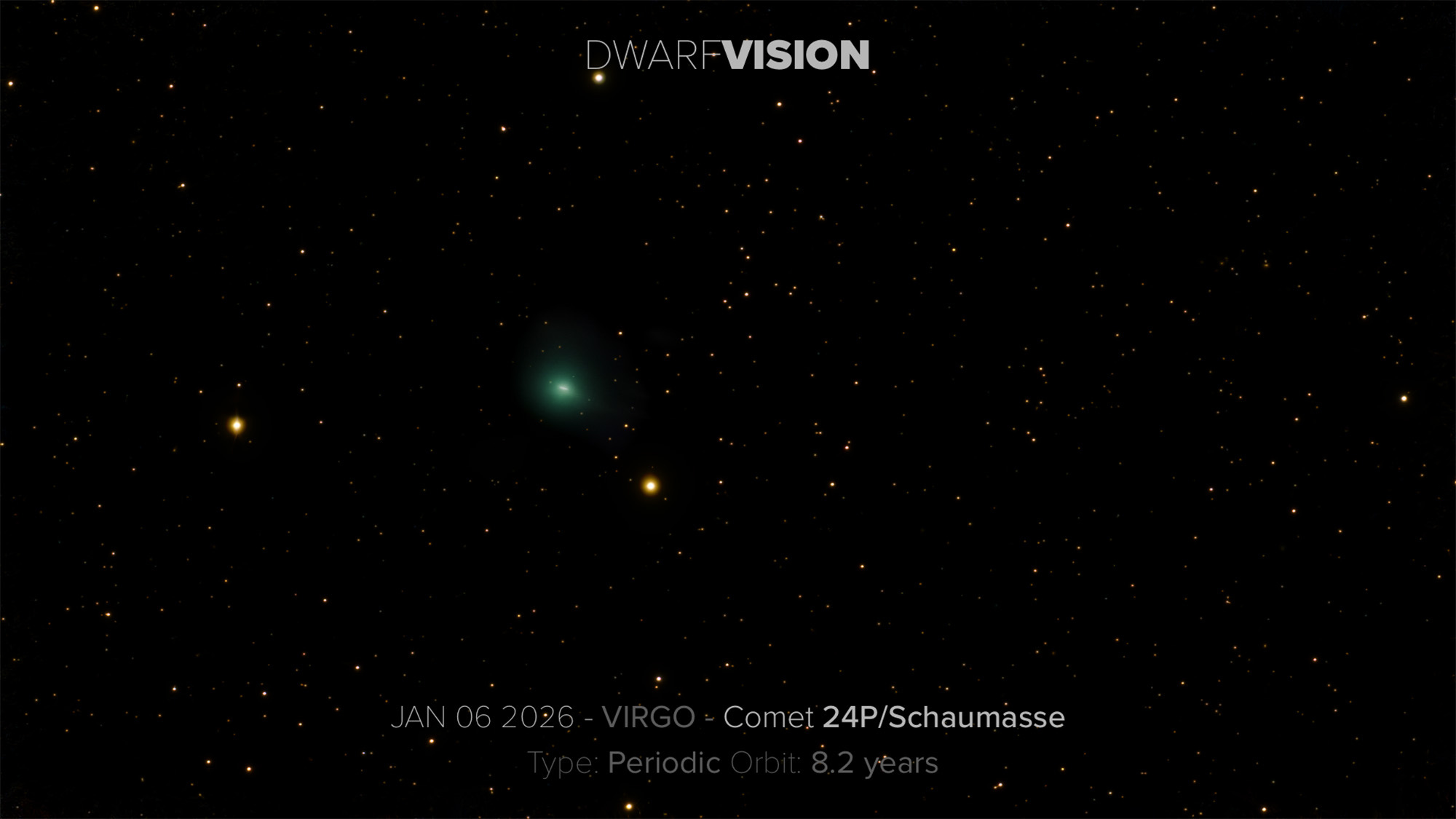
Comet 24P/Schaumasse: Brighter than expected (mag 9.5). Best 2:00 AM – 5:00 AM in Boötes. Settings: 30–60s subs to pull out the green coma.
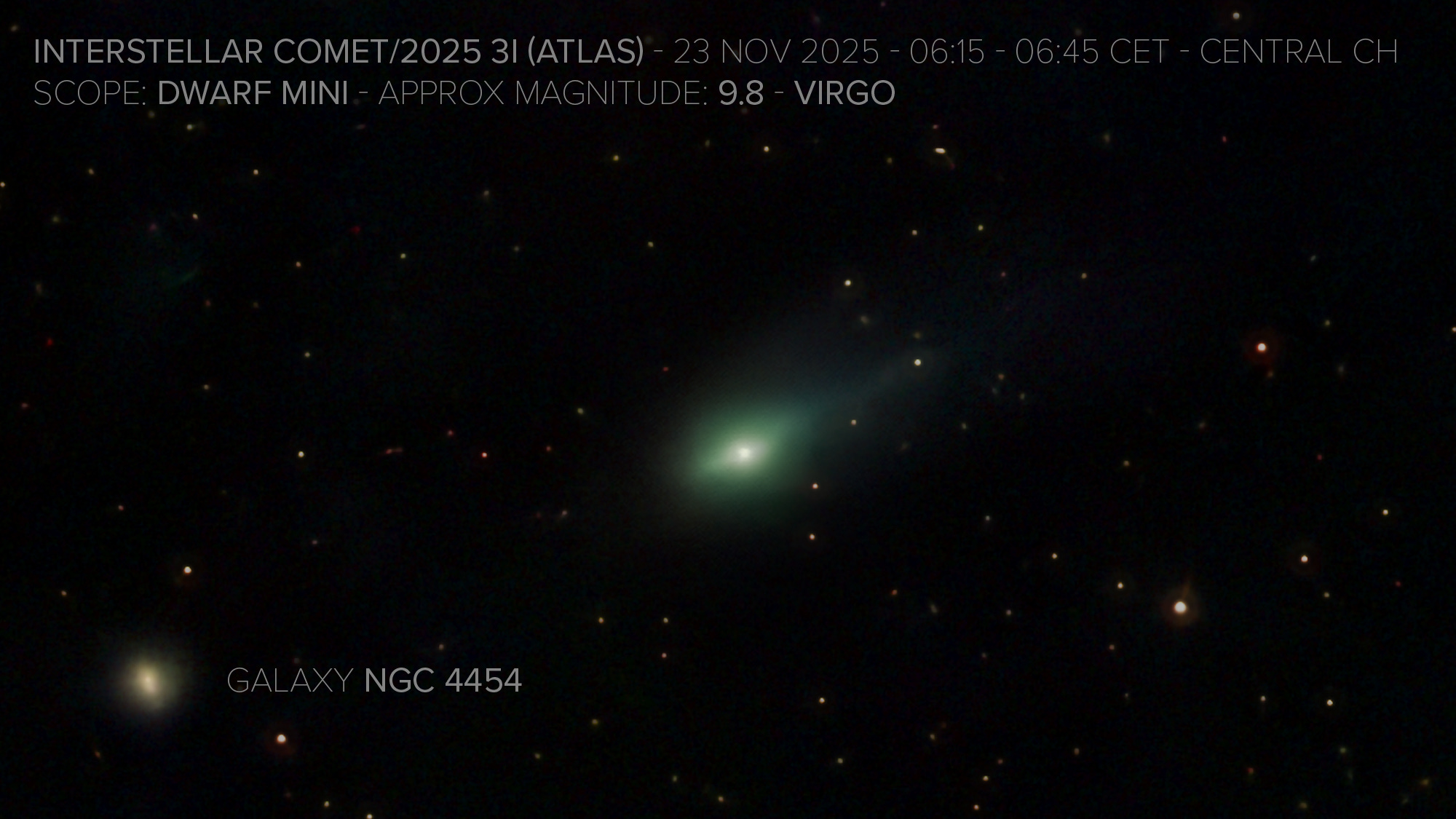
Interstellar 3I/ATLAS: Back in the news for its mysterious anti-tail and “opposition surge.” Settings: High-quality 15-minute “burst” stacks to track its high velocity.
Feb 15: Saturn & Neptune Meet: Last encounter until 2132. Manual Gain is a must to keep Saturn from blooming while catching Neptune’s blue glow.
Feb 17: “Ring of Fire” Eclipse: Remote path, but partial views for Australia (Tasmania) and Southern Indonesia.
Feb 28: Six-Planet Parade: The month ends with a “Full House” along the ecliptic. Use Pano-stitching as the stars emerge.
Reminder: Tag your Facebook captures with #DwarfvisionEvents and let’s witness the awe together!
Clear Skies!
Duncan & The DwarfVision Team
Outstanding breakdown of the standard candles concept for Type Ia supernovae. The fact that these white dwarf explosions always happen at the same critical mass is what makes them so valuable for measuring cosmic distances. I appreciate the practical timing advice too, catching SN 2026acd while it's still brightening is key. The 4-hour integration strategy makes sensefor pulling signal from 100 million ly away.
Which filter for the supernova 2026 -lease?