

Shooting on the Galactic Equator: Deep Sky Gems of the Rift - PART TWO
Smart-Scope Deep Space Targets on the Sagittarius-Scorpius Celestial Bridge

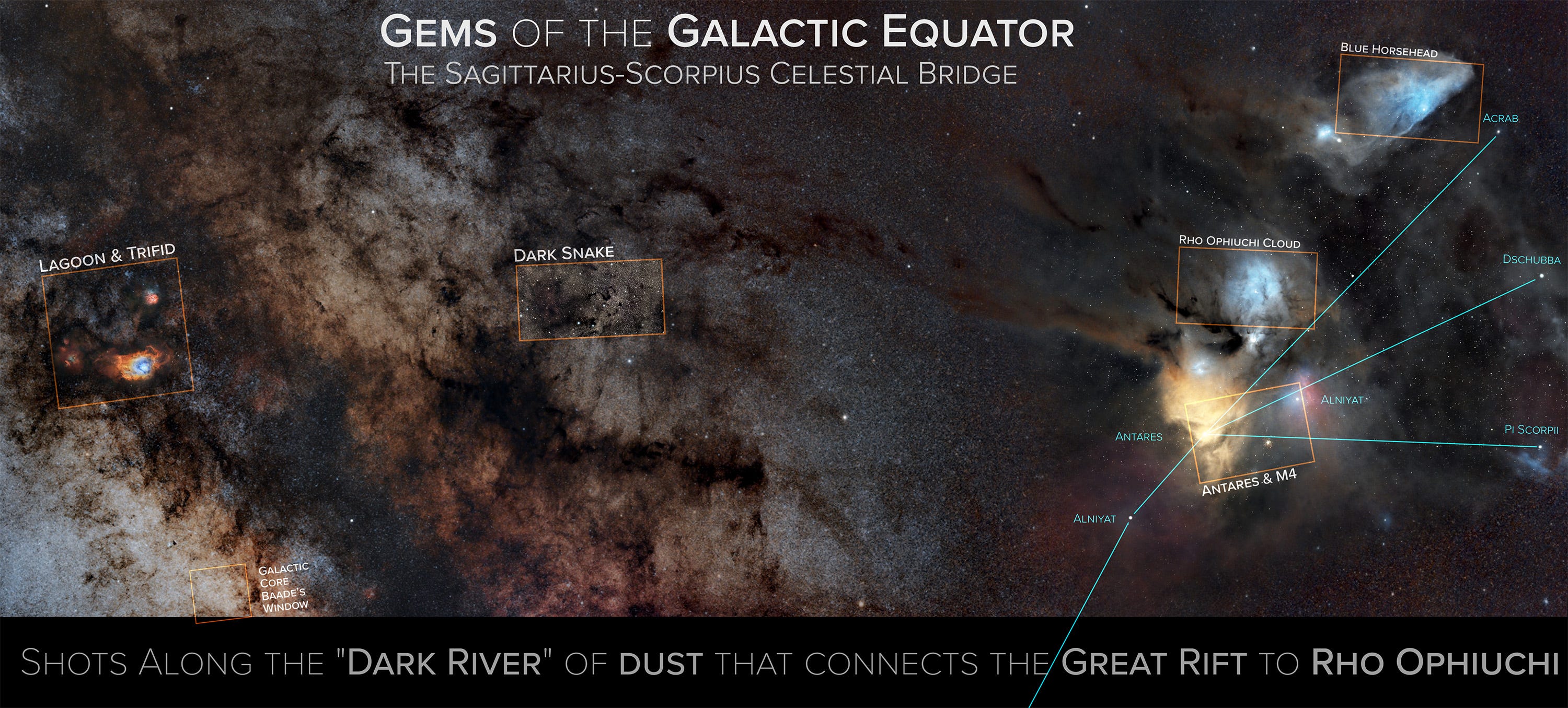
We continue our Milky Way tour north from the War & Peace Nebula to the very heart of Scorpio. Here we find the Rio Ophiuchi Cloud complex (the glowing yellow and blue clouds on the right), which is one of the closest and most iconic regions of sprawling nebulosity visible in the night sky in August.
Missed our last post? You can explore it here:

Its complex and extensive structure makes it one of the most difficult objects to photograph and observe. However, its stunning appearance still captivates astronomers, astrophotographers, and especially us Dwarfers, as we discovered that getting a good shot of such a vast structure is really a challenge.
Most notably, this entire stellar nursery is not an isolated island. As our wide-field panorama illustrates, a massive, ink-black pipeline of freezing molecular dust—astronomically known as the Dark River—stretches across the sky. It physically links the dense starfields of the Great Rift and the Lagoon & Trifid Nebulae on the left directly to the vibrant, active star-forming hub of Rho Ophiuchi on the right, providing a direct highway of cosmic raw material.
Shoot your own wide-field Milky Way using your Dwarf:

How to Capture the Milky Way Core: The Ultimate Wide-Angle Astro Photography Guide for Dwarf Scopes
Beneath its sprawling, multi-colored beauty, the Rho Ophiuchi complex reveals an intricate playground of cosmic depth and physical connection. While our panorama flattens the region onto a 2D view, the environment is actually a deep, 3D field of dust and light.
T3: The Rho Ophiuchi complex (IC 4604)
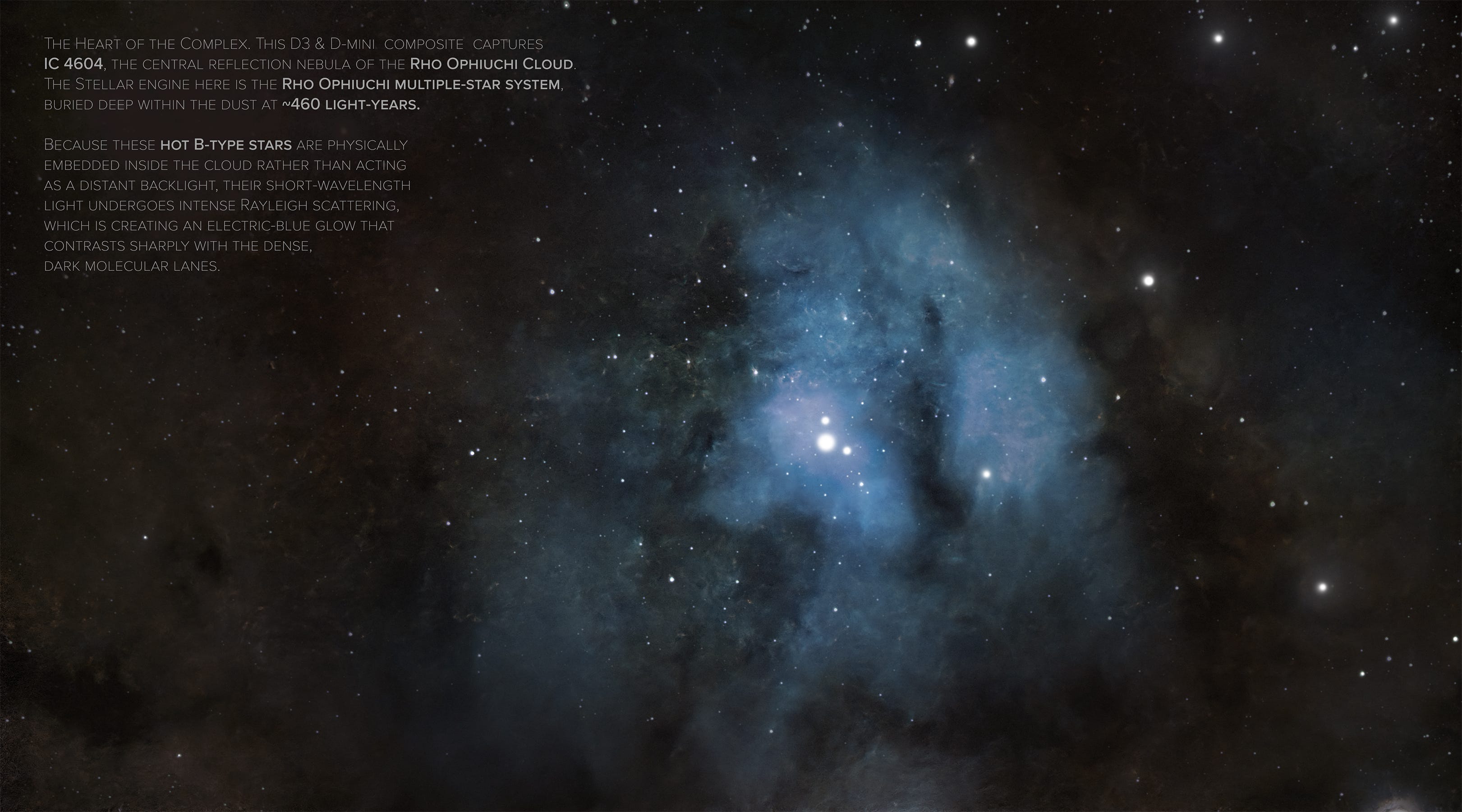
Located just 460 light-years away, the central Rho Ophiuchi Cloud forms the front curtain of the complex cloud structure. Lit from within, it stands as a classic example of a “reflection nebula.” At the center of this core lies the Rho Ophiuchi triple-star system, a bound trio of hot B-type stars completely enveloped in the cold dust cloud. Rather than shining from behind, these young stars act as internal illuminators, scattering short-wavelength blue light off local cosmic dust grains to create the vibrant electric-blue glow of the IC 4604 reflection nebula.
T4: The Blue Horsehead (IC 4592)
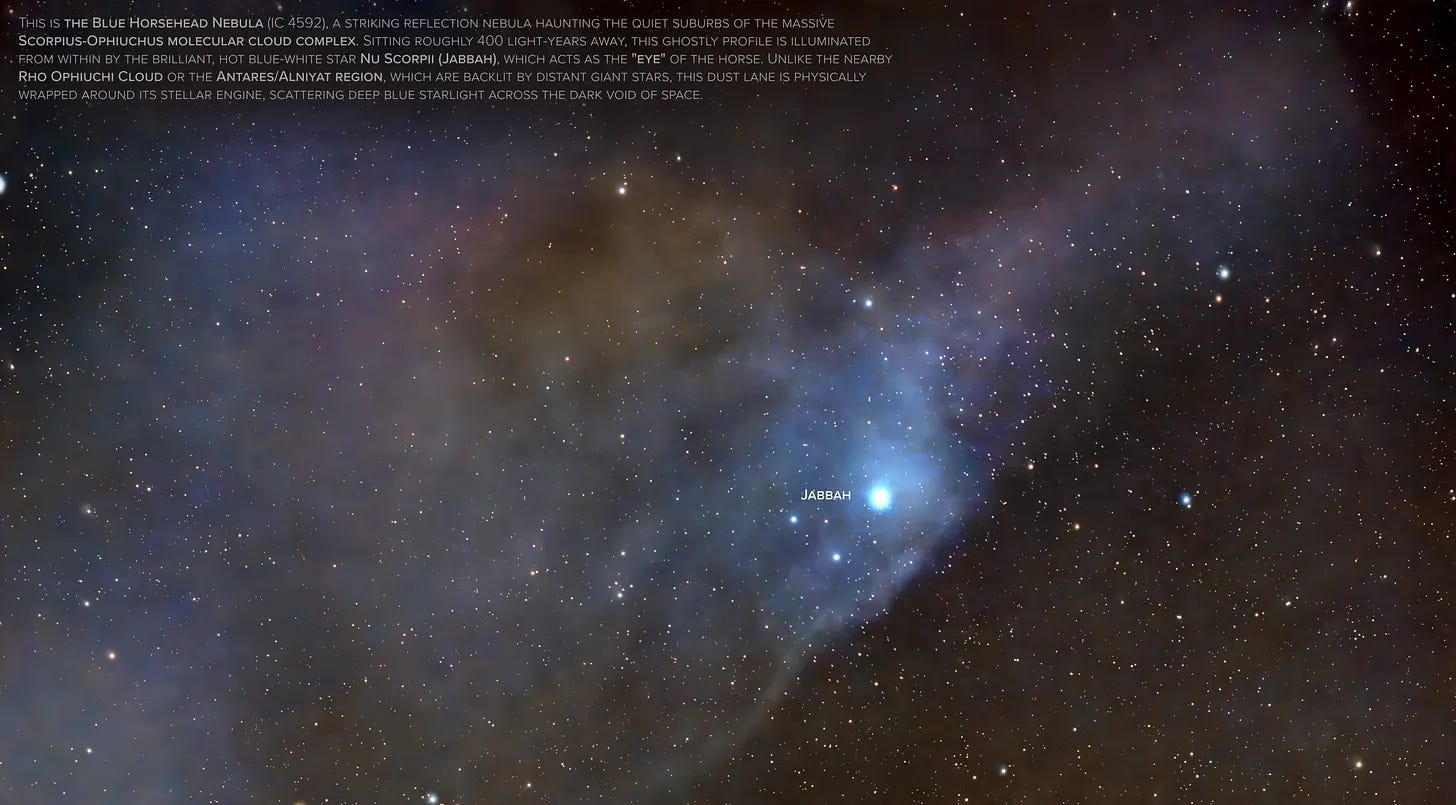
Also located about 400 light-years away, the Blue Horsehead Nebula (IC 4592) is a ghostly reflection nebula in the quieter outskirts of the Ophiuchus-Scorpius cloud complex, just north of the Ophiuchus triple-star system.
The stellar engine illuminating this striking silhouette is the brilliant blue-white star system Nu Scorpii, also known as Jabbah, which visually forms the "eye" of the horse. Unlike the nearby Antares and Alniyat regions that are illuminated from behind by background stars, this long, cosmic dust lane is physically wrapped directly around the star. This tight orientation allows Jabbah’s energetic, short-wavelength starlight to fiercely scatter off the surrounding interstellar dust grains, casting a deep, electric-blue glow across the surrounding dark expanse.
T5: Antares and Messier 4
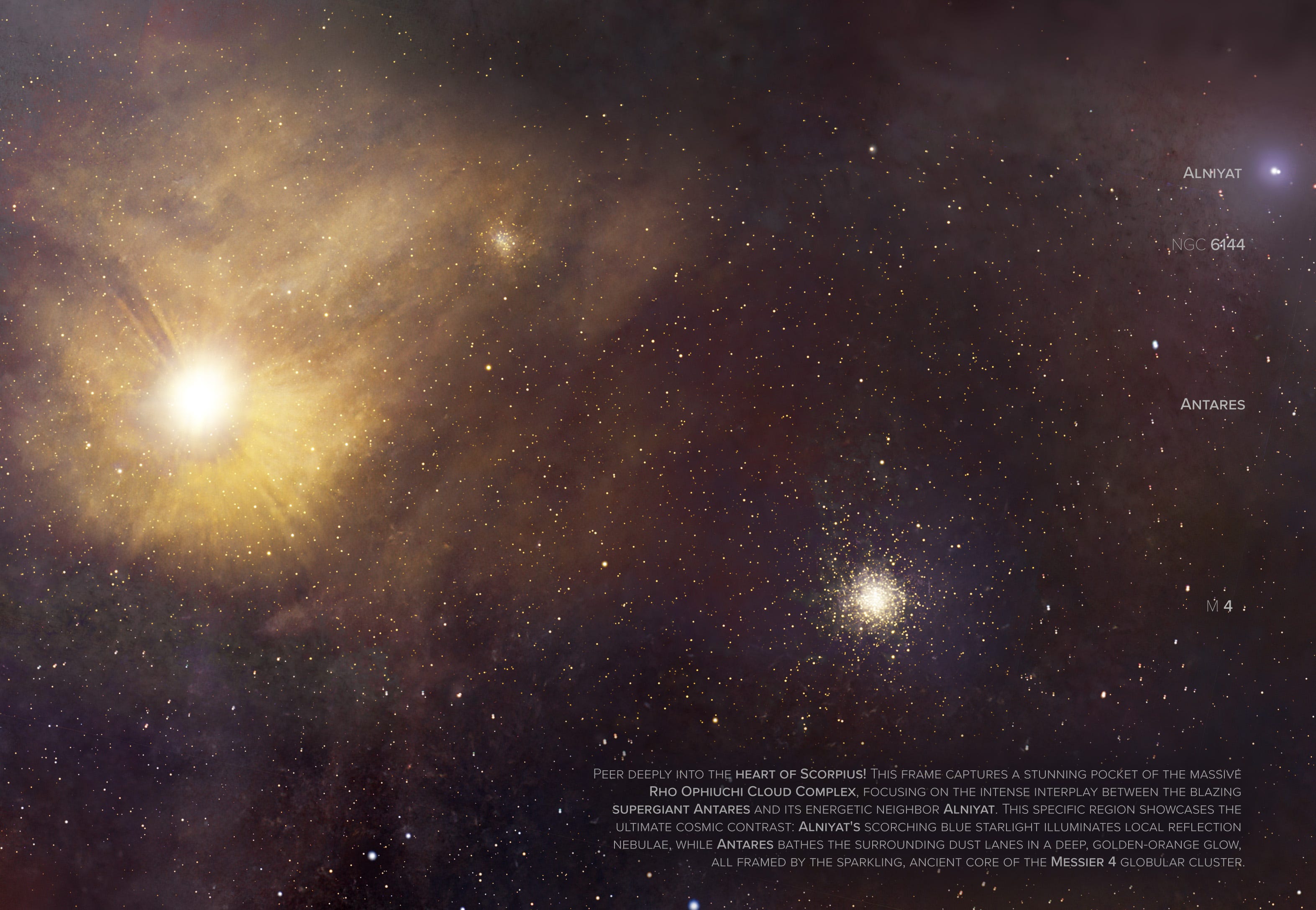
The striking golden-orange glow around the supergiant Antares and the purple-blue glow of its neighbor Alniyat are not inside the cloud, but sit roughly 100 to 250 light-years behind it, backlighting the interstellar dust like massive spotlights.
Deeper still, the ancient globular star cluster M4 shines through from a staggering 7,200 light-years away in the background, well behind the Milky Way’s plane.
Hidden in the same cosmic depth is the smaller, fainter globular cluster NGC 6144, located roughly 27,000 light-years away and buried deep within the background fog near Antares. Because this dense and distant stellar cluster lies directly behind the thick, dusty veil of interstellar material, the ancient starlight, having traveled for thousands of years, itself illuminates clumps of the foreground cosmic dust and gas, creating the visual effect of shimmering light, as seen through a foggy glass or misty window, enhancing the mysterious and layered appearance of this celestial gem.
T6: The Dark Snake (Barnard 72)
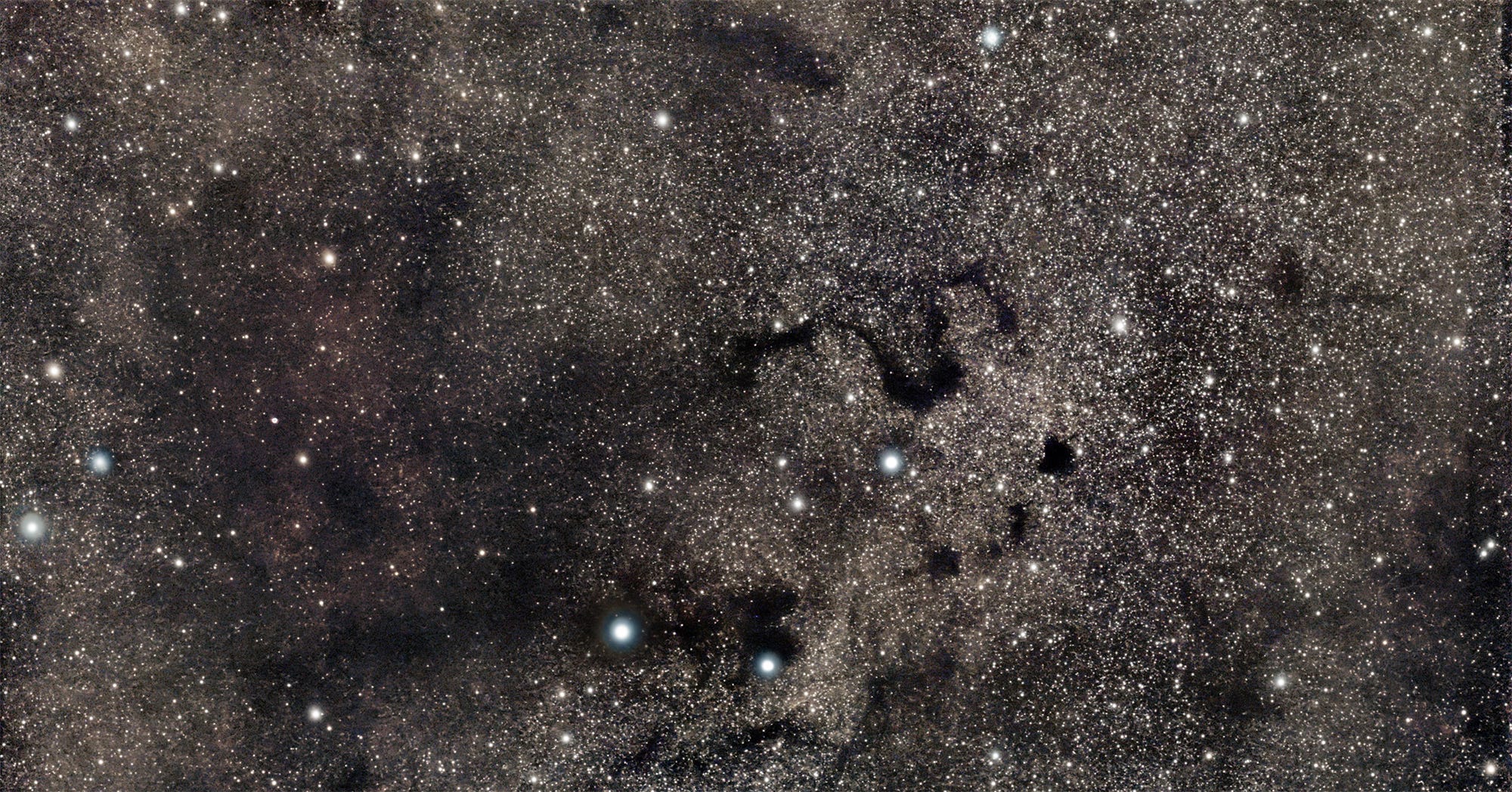
Slewing eastward midway between the Rho Ophiuchi Cloud complex and the Great Rift, the Snake Nebula (Barnard 72) is a compact, S-shaped dark nebula located approximately 650 light-years from Earth.
While it belongs to the same larger family of Ophiuchus-Scorpius molecular clouds, it actually sits at a slightly different depth and distance than its neighbors; it is roughly 200 light-years further out than the main Rho Ophiuchi Cloud (at ~460 ly), structurally extending from the northern edge of the massive Pipe Nebula dust complex, just to the south.
Rather than an empty void, the "S" is a dense, freezing expanse of interstellar dust and molecular gas that is completely opaque to visible light, creating an ink-black silhouette by absorbing the illumination from the crowded starfields directly behind it. Because we have shot straight through a “low-extinction” window toward the dense galactic bulge, this frame likely captures tens of thousands of individual stars inside this single Dwarf 3 field of view.
Our shot pierces clean through tens of thousands of light-years to resolve the ancient stellar populations packed near the distant heart of our galaxy.
Parting the Rift - The Lagoon & Trifid Nebulae
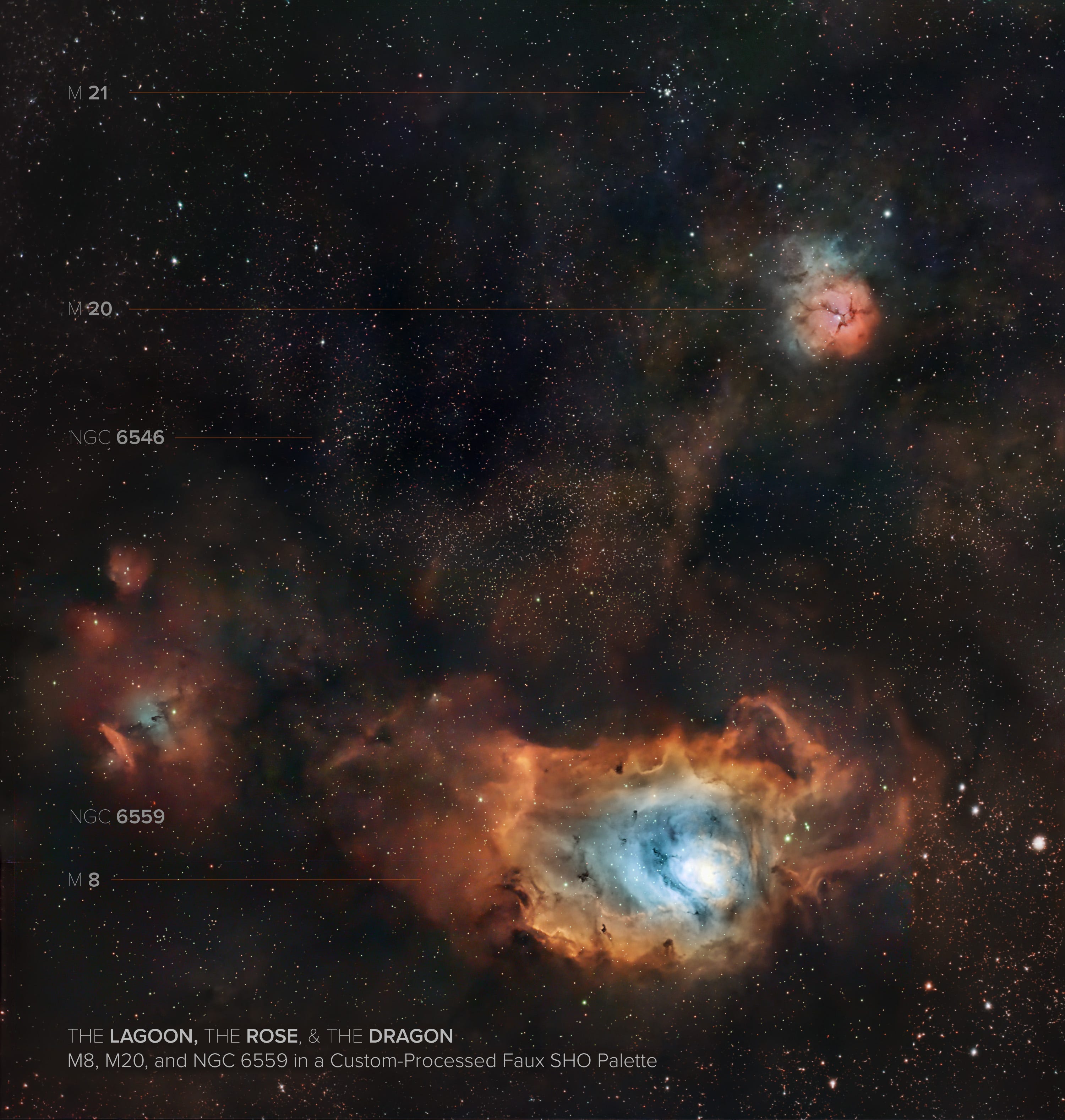
This brilliant cosmic display is visible only by chance. The heavy foreground curtains of the Great Rift—positioned just 800 to 1,000 light-years away—part cleanly over Sagittarius, creating another low-extinction window through the local interstellar dark nebulae.
Looking through this clearing allows your DWARF to pierce 4,000 to 5,200 light-years deep into the Sagittarius spiral arm. Here, the local foreground veins give way to an entirely separate, more distant network of dense molecular dark nebulae, rendered open at the hearts of M8 (The Lagoon) and M20 (The Trifid).
These deep-sky targets are powered by intense, newborn O- and B-type star clusters buried within their cores. The blisteringly hot stars unleash torrents of ultraviolet radiation and supersonic stellar winds, ionizing the surrounding gas clouds and carving out massive structural cavities. Our D3 & Dwarf mini captures utilize a Faux SHO Hubble palette; these extreme energy dynamics are mapped through distinct chemical signatures of sulfur (red), hydrogen (yellow to Green), and Oxygen (Blue).
T7: Trifid - The Rose of Sagittarius
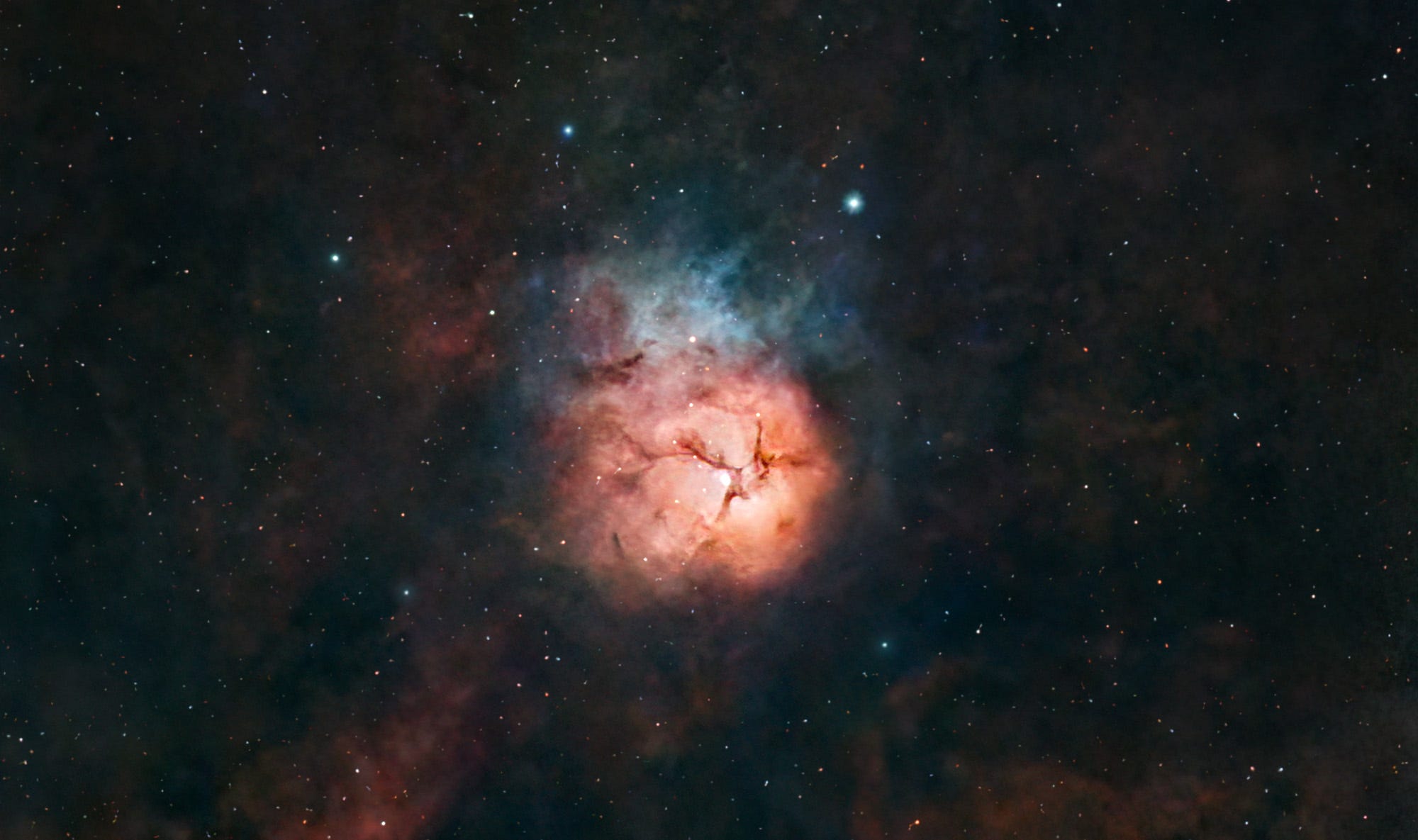
Our 20 hours of Dwarf Mini data, processed in SIRIL, beautifully reveal the subtle outer gas clouds and the complex network of dark tendrils cutting across the glowing, petaled core. These dark, delicate fractures are not part of the local foreground Great Rift. Instead, they are deeply embedded in the nebula itself, sitting in the background roughly 4,000 to 5,200 light-years away, where they act as freezing curtains of dense molecular dust sculpted by an internal hidden star cluster.
The Trifid is uniquely famous for packing three distinct types of astronomical nebulae into a single, cohesive deep-sky structure. The bright, central pinkish-orange sphere forms the emission nebula, a hot pocket of gas ionized by a massive, newborn star system whose intense ultraviolet radiation causes the hydrogen atoms to glow furiously. Wrapping around the top of this core is the reflection nebula, a ghostly blue-teal halo where fine interstellar dust grains act like a giant cosmic mirror, scattering short-wavelength blue starlight through Rayleigh scattering.
Slicing directly through both of these regions are the striking dark nebulae, cataloged as Barnard 85. These are the opaque, ink-black dust lanes filled with tightly packed carbon and silicate grains that completely absorb all visible light from behind, carving out the high-contrast fractures that give the Trifid its iconic, three-lobed name.
T8: The Lagoon
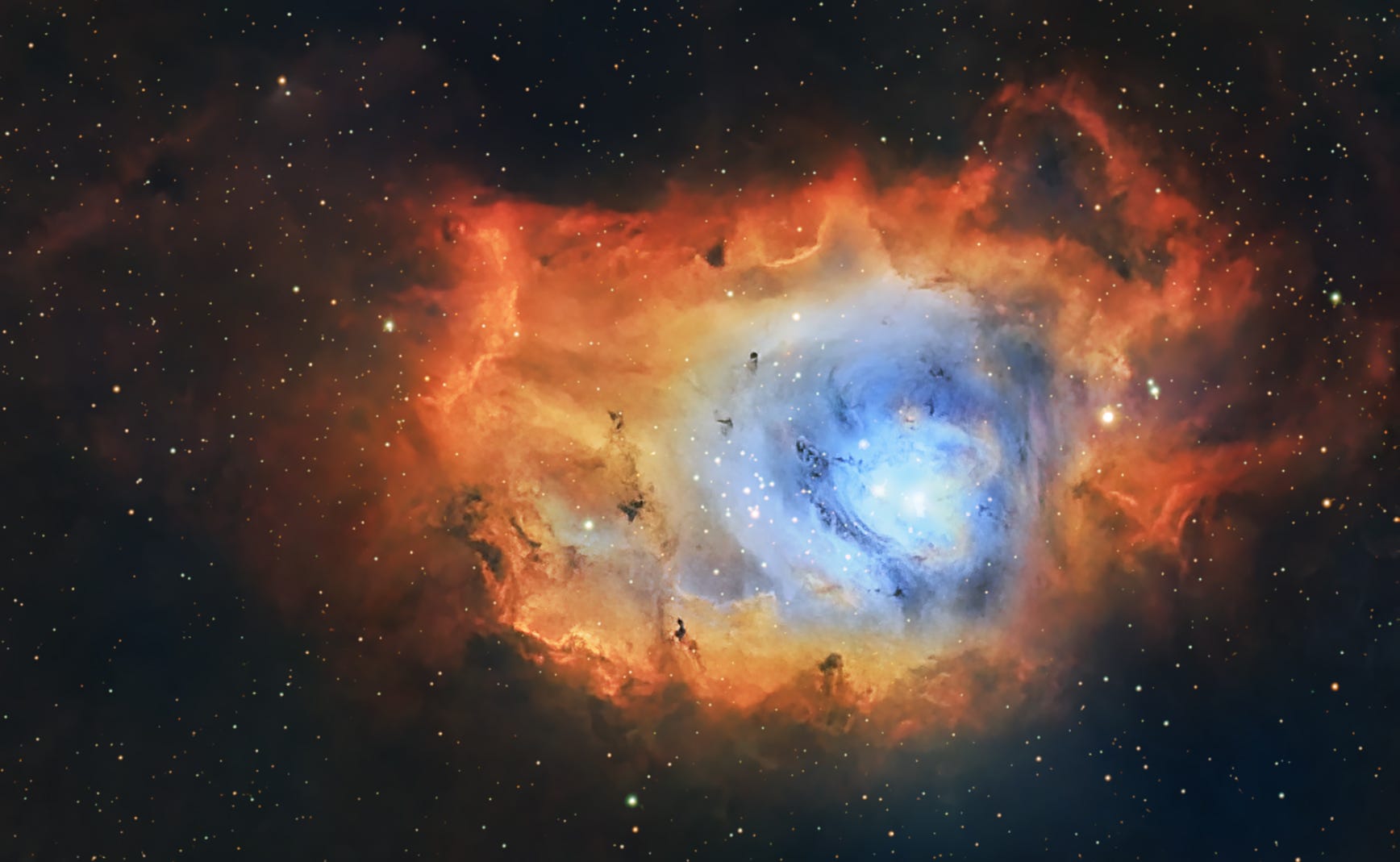
Our sharpest Dwarf-mini Lagoon Nebula (M8) capture showcases a breathtaking, deeply excavated stellar cavern situated roughly 4,000 to 5,200 light-years away. The core of this massive nebula is a hyper-energetic environment dominated by the Hourglass Nebula, a twisting, high-density knot of light shining near the center.
This entire region forms an immense, hollowed-out cosmic cavity that plunges several light-years deep into its parent gas cloud. It is actively being carved out by a central open star cluster, whose blisteringly hot, massive stars act like a localized structural blowtorch. Their relentless supersonic stellar winds and intense ultraviolet radiation violently push back the surrounding gas, sculpting the towering dust pillars and sharp, high-contrast ridges that form the cavern’s deep, layered walls.
The incredible colors of our Faux SHO Hubble palette perfectly map the extreme energy distribution within this deep structural gulf. The vibrant, electric-blue core highlights the highest-energy zone, tracing the highly excited Oxygen-III signal closest to the central stellar engines, where the radiation is strong enough to double-ionize the gas.
As you move further out into the cavern, the palette transitions into brilliant, fiery golds and deep copper-reds. These tones trace the cooler, lower-energy boundaries dominated by Hydrogen-alpha and Sulfur-II emissions, mapping the exact shock-front lines where the expanding star-blown bubble is actively slamming into the freezing, dark molecular dust lanes of the interstellar medium.
In our next post, we continue our journey northward through star clouds and the stunning gems of Scutum — The Omega and Eagle — plus many more surprises! Be sure to subscribe and not miss our largest DATACLUB drop ever — all the nebula files to apply to your Post-Processing endeavors, everything you need to become a DWARF POST-P Master.
If you’re ready to master exactly our Workflow. Download our “Gems of the Rift” PRO GUIDE, plus get immediate access to our growing library of GUIDES written exclusively for DWARFERS!
Clear Skies! - Duncan, Founder of DwarfVision
Already a member of our CREW? Scroll down to download this CAPTURE & PROCESSING ProGuide on these GEMs of the RIFT and take your skills to the next level.
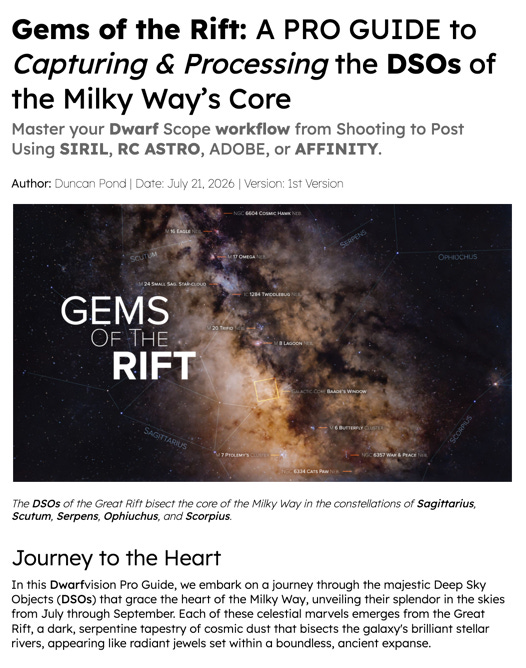
The guide contents at a glance:
Target Selection: A guide to locating iconic nebulae within the Great Rift, including the Cat’s Paw, War & Peace (Lobster), Lagoon, Trifid, Omega, and Eagle nebulae.
Our Astro-Photography Workflow: Learn our complete A-to-Z pipeline for imaging celestial marvels, covering session capture settings, stacking in SIRIL, and using AI-driven tools like RC Astro’s (BlurXTerminator, NoiseXTerminator) to refine your images.
Software How-Tos: Detailed advice on using a mix of free and subscription tools, including SIRIL, Affinity Studio (with JR’s Macros), and Adobe Photoshop (with SyQon’s Prism Deep), to achieve professional, “Hubble-like” SHO palette results.
Technical Tips for DSOs: Practical steps for achieving high-quality images with your Dwarf Scope(s), including specific EQ mode alignment, exposure settings for dark skies, and advanced color balancing techniques to isolate narrow-band signals like OIII.
Scope corner

Don’t have a DWARF scope yet? Or looking for an upgrade to the small but powerful DWARF mini? Then consider contributing to DwarfVision by purchasing your DWARF via our affiliate link:
