

The Sculpted Void: Gravity's Dance, Distant Giants and the DEEP FIELD (Galaxy Season Part III)
From the Antennae to the 3 Billion-LY Edge. Mastering the Noise Threshold in the DEEP FIELD

In Part III, we move beyond stable galactic structures to witness the Sculpted Void. We are entering regions of space where gravity acts as a master architect—not through conflict, but through a grand, invisible choreography that stretches space-time and ignites starburst “rubies” across the deep field.
Ready to join the challenge? Learn more HERE
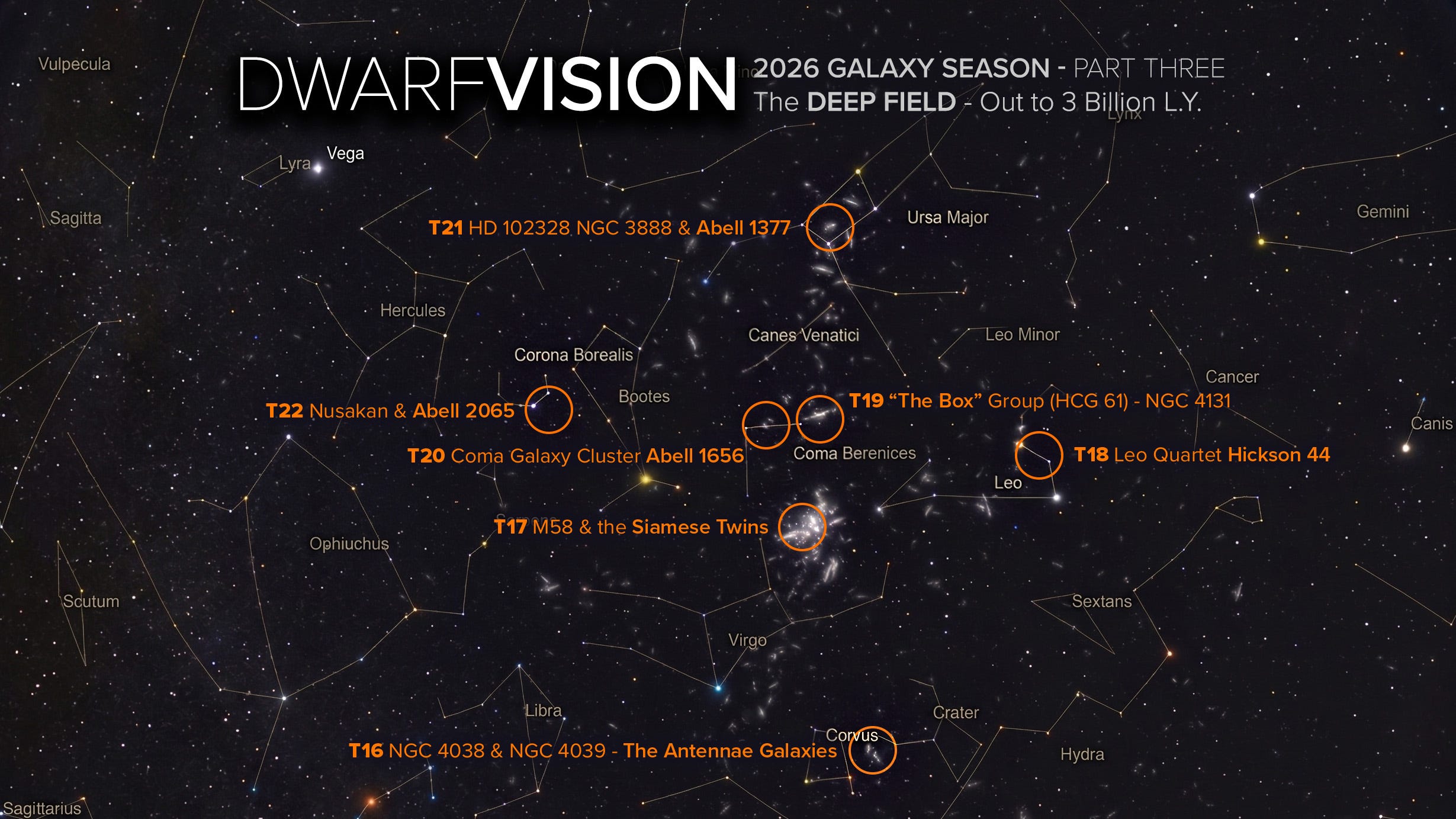
This is the Integration + Resolution Frontier. What truly makes this phase profound is realising your DWARF scope functions like a time machine. It transforms ancient photons travelling for hundreds of millions – and in some cases billions – of years into digital signatures and breathtaking final images.
Love these deep dives into our cosmic neighborhood? Consider upgrading your membership to paid and support our work - Plus, gain access to our comprehensive PRO guides and the DATACLUB.
To resolve these delicate signals from interacting galaxies and the massive Distant Giants anchoring distant clusters, we must leverage every tool in our photobox, from multi-session long-exposure Astro filter captures to the surgical gas isolation of the Duo-Band filter when colorful phantoms hide in the shadows.
POST-P TIP: The Noise base, Astro and Duoband: Revealing the invisible in Markarian’s Chain
Before we engage our challenge targets, we look to the heart of the Virgo Cluster for our deep study in integration. Our 25-hour Deep Dive of Markarian's Chain:
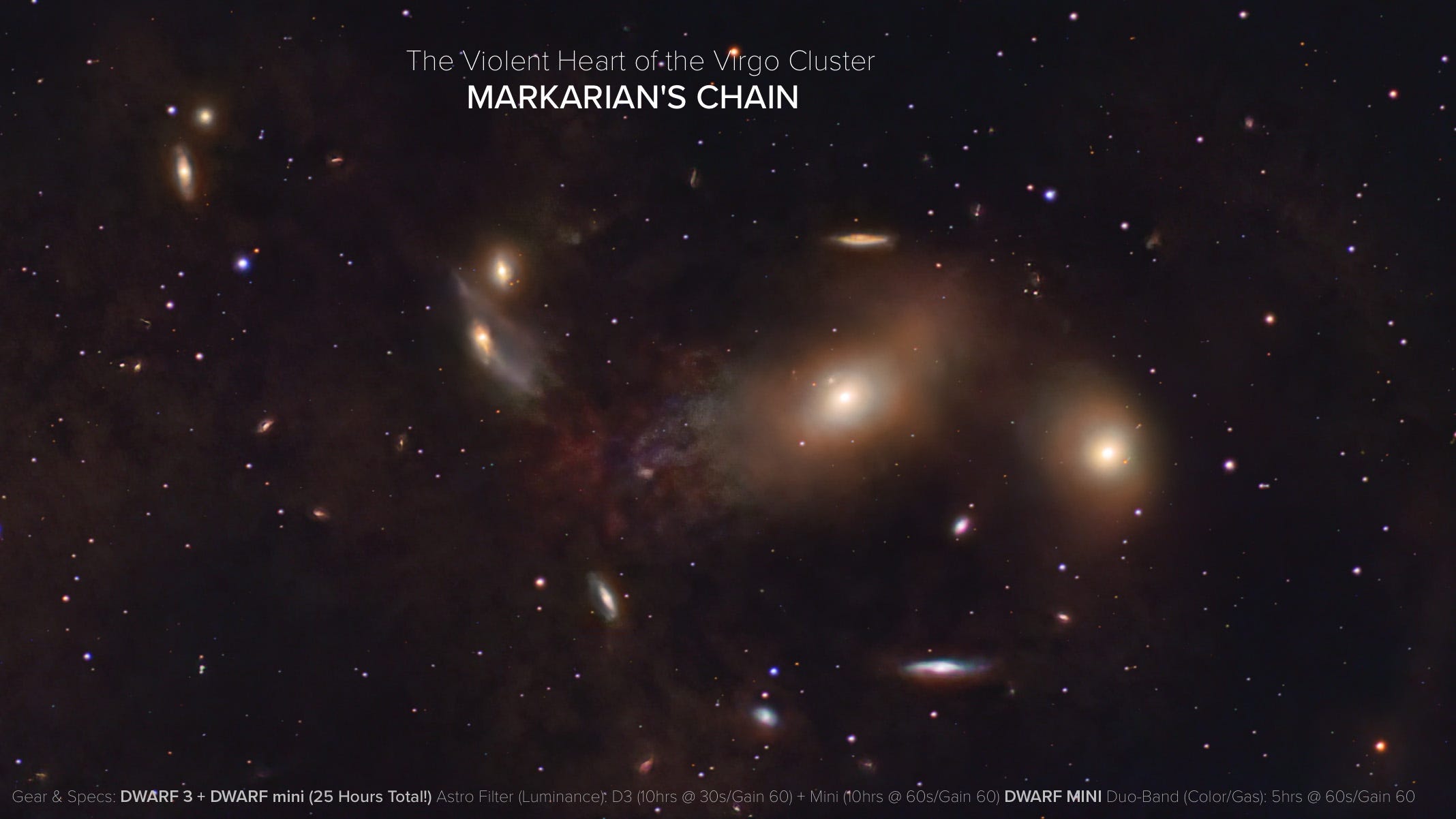
Behold the violent heart of the Virgo Cluster—Our capture reveals an intergalactic architecture I never thought possible, with a DWARF mini.
Located 50 million light-years away, the mini’s compact optics function as a true time machine. They unveil the ghostly “Kenney Bridge” of ionized gas and tidal stellar streams connecting the Eyes to M86. It’s a cosmic record of a massive encounter, exposing gravity's invisible influence as it twists and molds large star systems like cosmic clay.
The magic of this frame lies in its complexity, layering the local and the deep into a single view. The dual filters acted as light nets, snaring the deep starburst “fires” and the faint, textured “soot” of the Integrated Flux Nebula (IFN)—ghostly dust clouds within our Milky Way that hang like a curtain before the void.
The Forge: Triple-Plate Noise Elimination
How do we prove these faint wisps are real and not just sensor artifacts? To turn this “noisy smudge” into a scientific document, we developed a Triple-Plate Verification method.
Pro-Level Technique: To eliminate purely sensor-based noise, I compared three distinct datasets: Dwarf 3 (Astro Filter), D-mini (Astro Filter), and D-mini (Duo-Band). By stacking and comparing all three, it became clear what was random, unaligned noise on a single plate versus the structural reality captured by all three sensors. Using Layer Masks and “similar” selection options in Photoshop, I isolated the shared structures across all three frames, then inverted the selection to delete the noise. If a wisp appeared in all three sessions using different hardware and filters, it wasn’t noise. It was the universe.
The Orchestration of a Cosmic Merger
GST16: The Antennae Galaxies (NGC 4038 & 4039)
Distance: 45 Million Light-Years
Constellation: Corvus
Classification: Interacting Spiral Galaxies
At 45 million light-years away, we encounter one of the most stunning examples of gravitational choreography in the known universe. The Antennae Galaxies were once two independent spiral systems, much like our own, that have now begun a slow-motion, multibillion-year merger.
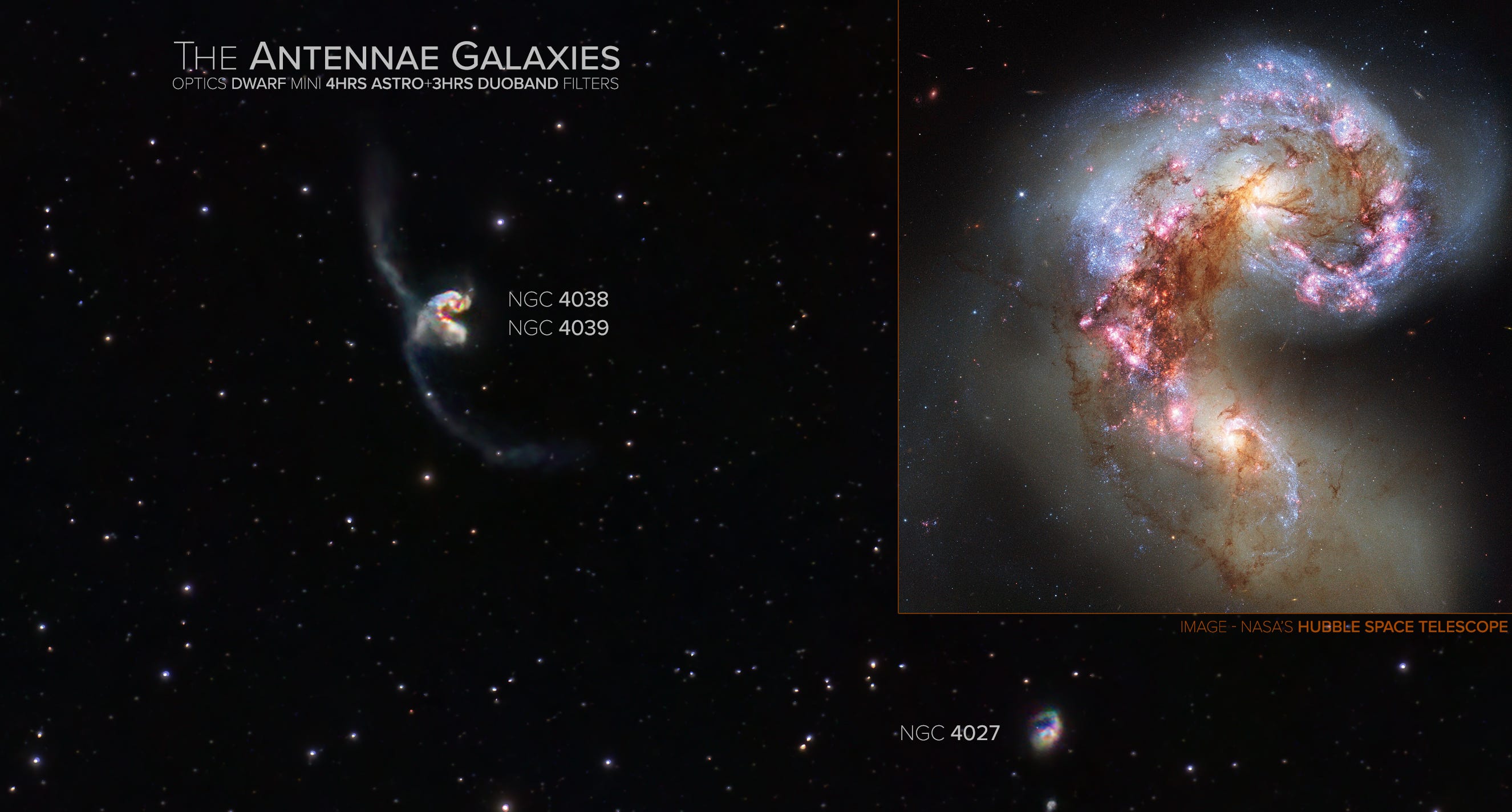
What we see as the long, sweeping “antennae” are actually massive tidal tails—streams of billions of stars and gas clouds physically stripped away from their host galaxies by the sheer force of gravity. This is the Sculpted Void in action. These tails aren’t just lines of light; they are a record of the path these galaxies have taken as they circle one another in a graceful, high-stakes dance.
POST-P TIP: Double Up: Use a Two-Filter Combo for the best Color Presentation
To achieve the best possible dynamic range and color fidelity on this target, I combined a 4-hour Astro filter session with a 3-hour Duo-Band session. The Duo-Band data were critical for pulling out the intense H-alpha “starburst” regions within the colliding cores.
In SIRIL, I used SPCC (Spectrophotometric Color Calibration) to ensure scientific color accuracy and applied VeraLux HMS stretches to preserve the delicate structural details of the tidal tails while increasing the intensity of the galactic cores. When you compare our result to the iconic Hubble Space Telescope view (shown in the right-side inset of our capture), it is truly mind-blowing how much color & detail our mini sensor can resolve from the backyard.
Gravity’s Kiss
GST17: Gravity’s Kiss: M58 and the Siamese Twins
Distance: 60 Million Light-Years
Constellation: Virgo
Classification: Barred Spiral (M58) & Interacting Spiral Galaxies (NGC 4567/8)
Behold “Gravity’s Kiss,” a 60-million-light-year glimpse into intergalactic intimacy captured via our Dwarf mini mosaic, combining four hours of data on M58 (NGC 4579) with four hours on the Twins themselves. The area is a “layer cake” of gravitational choreography; while M58 anchors the upper left with its prominent bar structure, the massive grand-design spirals NGC 4567 and NGC 4568 (The Siamese Twins) are locked in a slow-motion, symmetrical embrace, their outer arms overlapping at the moment two separate worlds begin to merge. Resolving that delicate touch alongside the ghostly foreground veils of our own Milky Way’s Integrated Flux Nebula (IFN) is a definitive “Pro-Level” milestone on the integration & resolution Frontier.
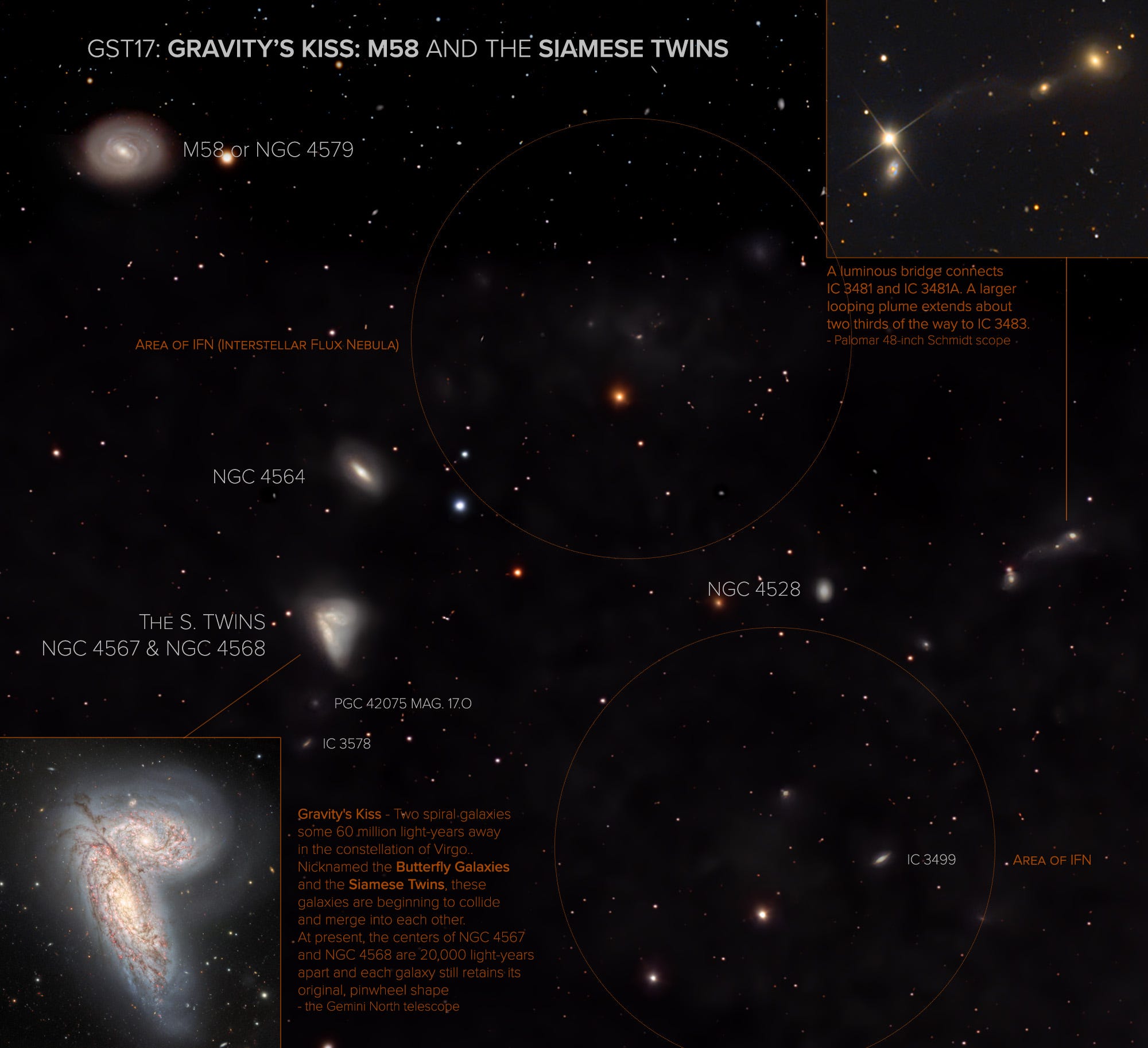
The true reward of deep integration, however, came unexpectedly during post-processing. I only looked up the faint interactors IC 3481 and IC 3481A after seeing an unmistakable connecting smudge appear in my stretches, discovering later that Palomar’s 48-inch Schmidt Scope image confirms a distinct Luminous Bridge connects the pair.
Finding these scientific surprises, invisible to the eye yet faithfully recorded by these tiny sensors, again proves that DWARF optics are legitimate time machines capable of deep-space discovery. From the violent fires of the Antennae collision to this gentle kiss, we are on our way to revealing the invisible forces that sculpt the void.
Gravity’s Dancers
GST18: The Leo Quartet (HCG 44) – Distant Island Chains
Distance: 80 Million Light-Years
Constellation: Leo
Classification: Compact Galaxy Group (Hickson 44)
At 80 million light-years, you aren’t just looking at a chance alignment of galaxies; you are witnessing a bound community of galactic islands functioning as a single gravitational unit. In this DWARF MINI zoomed-in field of view, we resolve a tightly packed “island chain” of four distinct galactic worlds.
The center is anchored by the massive NGC 3190, a striking edge-on spiral showing a sharp, prominent dust lane. The smooth, bright elliptical NGC 3193 dominates the top of the chain, while the barred spiral NGC 3185 anchors the bottom.
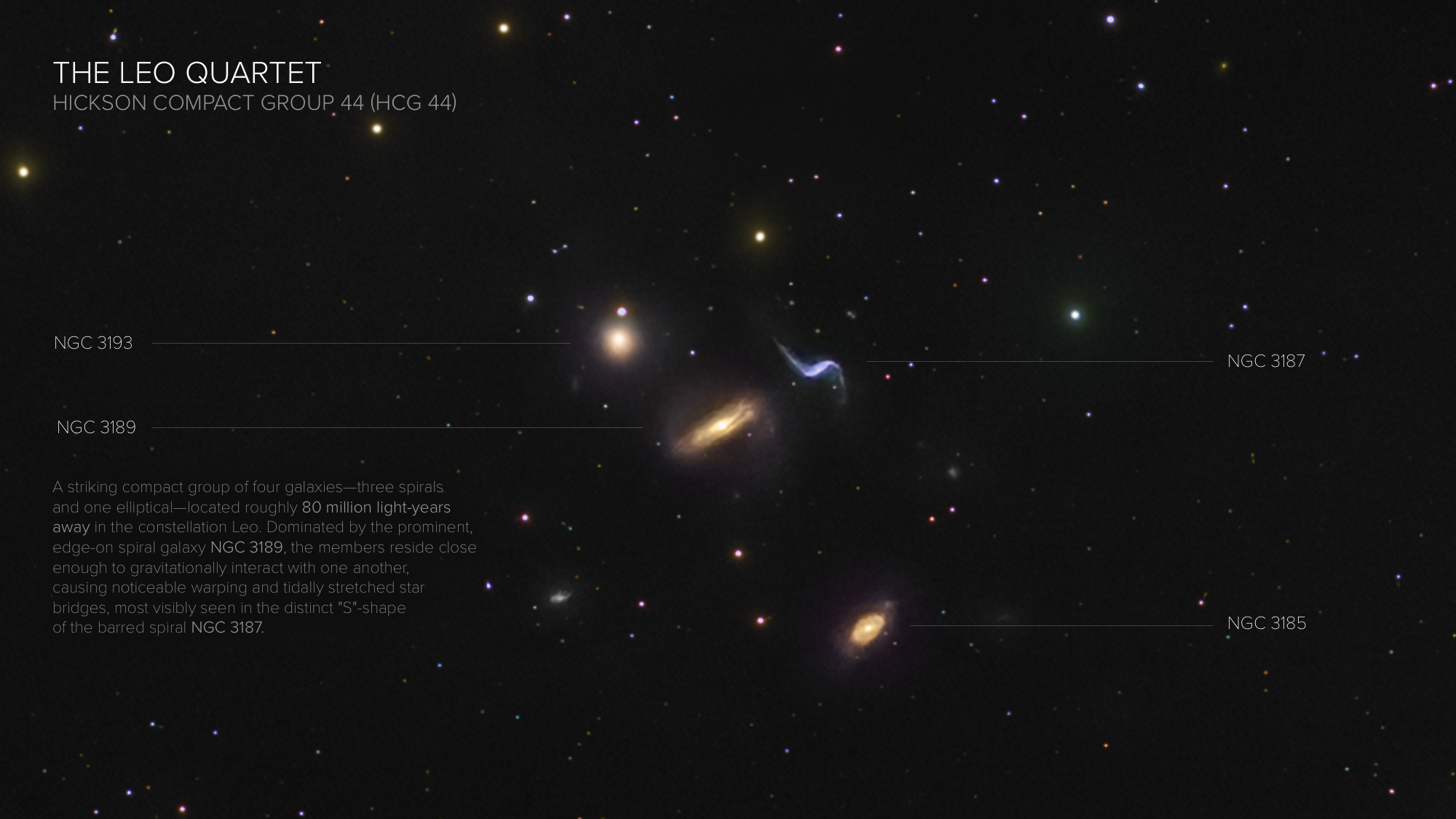
The Resolution & Color Challenge: NGC 3187
The true test of your optics is the fourth member of the quartet: NGC 3187. This is a warped, “S-shaped” spiral that is notoriously difficult to pull out of the background noise. Resolving its delicate, twisted arms at this distance is the ultimate proof of what a compact sensor can achieve with proper integration and modern noise management.
The Blue Outlier: Why the Color Matters
The second challenge is distinguishing its distinctive blue hue from the warm, yellow tones of the other three members. While NGC 3190 and NGC 3193 are dominated by older, cooler stars that glow with a golden, “suburban” light, NGC 3187 is a vibrant laboratory of stellar birth.
The intense blue color is a direct consequence of the quartet’s gravitational dance. As these galaxies interact, tidal forces stretch and compress the gas within NGC 3187, triggering a massive “starburst” event. You are seeing the collective radiation from millions of young, hot, massive O- and B-type stars. These “blue giants” burn fast and bright, illuminating the galaxy’s warped arms and providing a striking chromatic contrast to its ancient neighbors. Resolving this “starburst blue” alongside the dust lanes of its companions is the definitive milestone for Small-Format Mastery.
The 2-Billion-Light-Year Gaze
GST19: “The Box” Group (HCG 61), NGC 4131 Trio, & Abell 1495
Distance Range: 180 Million to 3.8 Billion Light-Years!
Constellation: Coma Berenices
Classification: Compact Group (HCG 61), Background Triplet, & Deep Field Trophies
A Journey Through Deep Time:
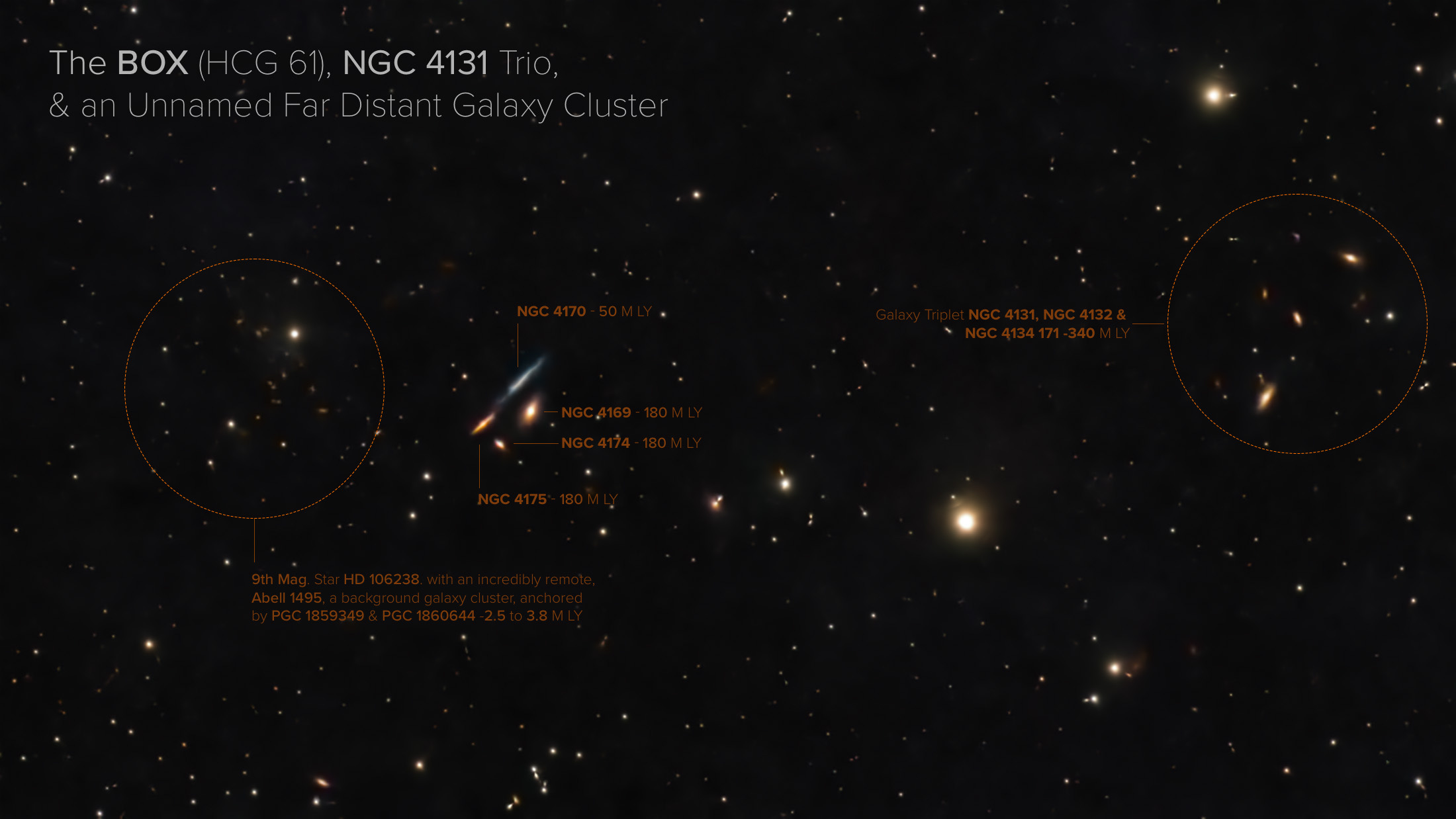
In this zoomed-in mini-capture, we are looking through layered “sheets” of cosmic history that span nearly half the age of the Earth. On the right of the image, we resolve a tightly packed galaxy triplet featuring NGC 4131, NGC 4132 (201 million light-years), and NGC 4134 (171 to 175 million light-years) — shining far behind the local Coma I Cluster.
As we move left, we encounter the geometric marvel of “The Box” (Hickson Compact Group 61). This is a profound WOW in 3D perspective: while the diffuse spiral NGC 4170 appears to be a member of the rectangle, it is actually a foreground “imposter” sitting just 43 to 50 million light-years away. The other three corners of the box—NGC 4169, NGC 4174, and NGC 4175—are physically interacting across a void 180 million light-years deep.
But the true “Small-Format Mastery” trophy lies completely outside the Box, lurking right in the glare of the brightish 9th-magnitude foreground star HD 106238. Tucked tightly around this stellar beacon is the incredibly remote background galaxy cluster Abell 1495, anchored by PGC 1859349 and PGC 1860644. The grouping has about 150 members. While HD 106238 is practically in our galactic backyard, the light from these far-off islands has traveled across an immense distance of 2.5 to 3.8 billion light-years through deep space, is heavily redshifted, and shines at a faint magnitude of ~17.63! Resolving a distinct, clustered structure at such staggering cosmological depths with the compact sensors in our tiny scopes is definitive proof that we have turned our tech toys into legitimate deep-space time machines!
Capture Notes: Resolving the Invisible
Achieving this depth required a long integration time, combining two 4-hr Astro Filtered shots in SIRIL to keep the background noise floor below the signal from these remote visitors. The challenge was two-fold: preserving the coloration of the BOX members, the blue of NGC 4170 at 180 MLY, and the yellows of the other three, while simultaneously resolving “background surprises” like the incredibly faint PGC 1859349 and PGC 1860644 of Abell 1493 (Mag 17.73). Finding these scientific rewards tucked into the dark void is what makes our shared cosmic adventure so rewarding.
The Galactic DEEP FIELD Galaxy Clusters
GST20: The Great Coma Swarm – Abell 1656
Distance: 321 Million Light-Years (Redshifted)
Constellation: Coma Berenices
Classification: Abell Class 2 Richness-4 Hyper-Cluster
The Metropolis of the Deep Sky:
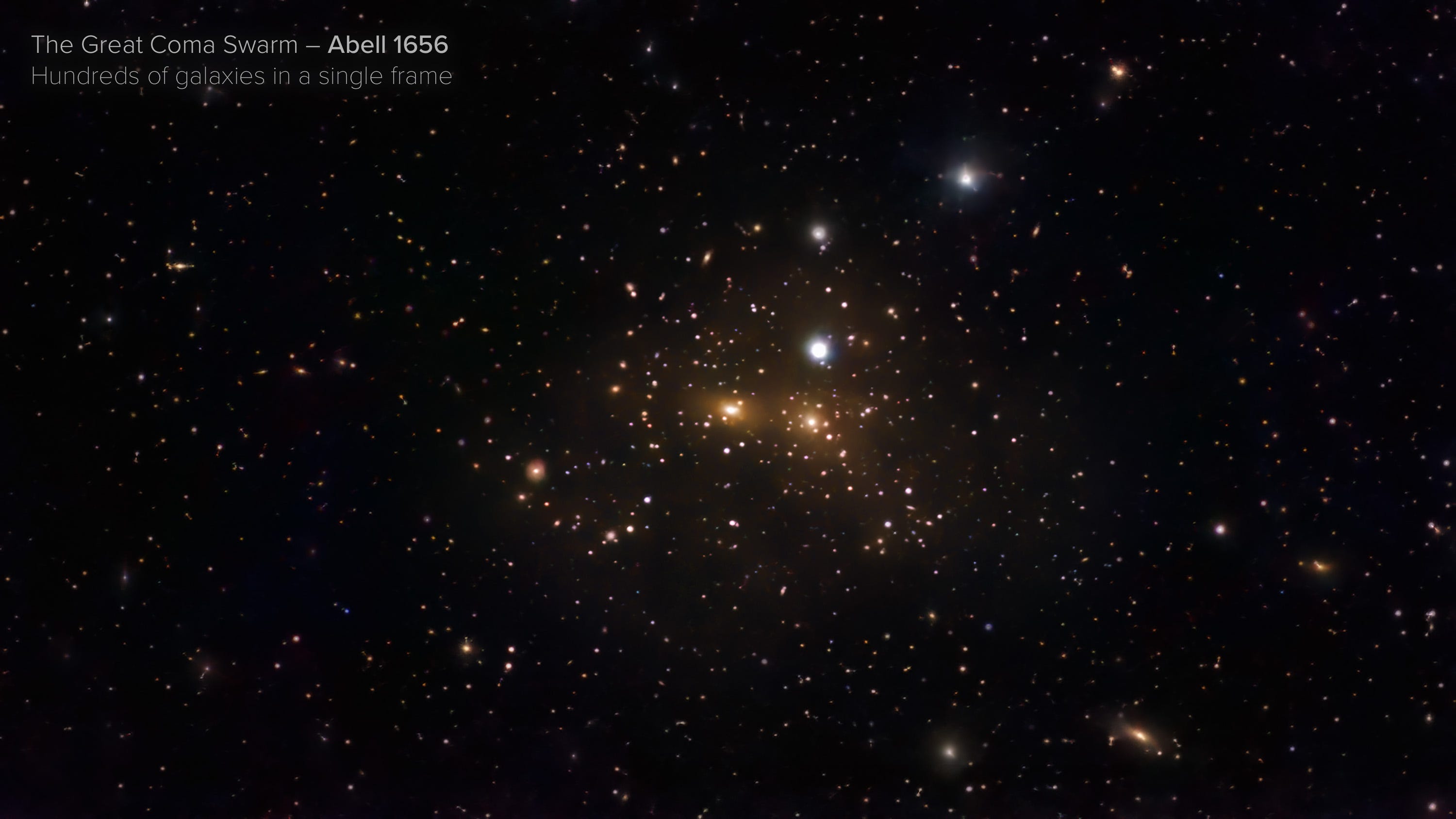
After navigating the sparse “Islands” and “Chains” of our local and the Virgo cosmic web, we have officially breached the absolute metropolis of the deep sky: Abell 1656, the Great Coma Cluster. Peering across a third of a billion years of light-travel time, we are looking at the foundational scaffolding of the universe—a colossal, dark-matter-dominated gravitational hub containing over 1,000 dense island universes packed into a core only millions of light-years across.
This cosmic megacity is anchored by two supergiant elliptical monsters: NGC 4889 and NGC 4874. NGC 4889 alone harbors a central supermassive black hole weighing a mind-boggling 21 billion solar masses. In our DWARF mini capture, the sheer scale defies comprehension, revealing a ghostly, unmistakable central background glow. This isn’t gas or nebulae; it is Intracluster Light (ICL)—a vast ocean of billions of “homeless” orphan stars and displaced globular clusters violently stripped from their home galaxies by extreme gravitational tidal shredding. Nearly every other faint, golden smudge shimmering through this stellar fog like a “cloud of fuzzy bees” is an independent galaxy holding up to a trillion stars. This is the ultimate “Resolution Frontier” capture, proving our ultra-portable optics can map both the macro-structure and the violent evolutionary history of a massive cosmic cluster across deep time.
Capture Notes: Resolving the Swarms
Resolving the Great Coma Swarm is the definitive test of target Signal-to-Noise Ratio (SNR) and extreme processing restraint. At 321 MLY, photons from these faint systems strike our compact sensor at magnitude 13 to 18+, sitting right on the jagged edge of the thermal noise floor.
Deep Integration is King. Integration is everything for successfully separating the ‘bees’ from the ‘static.’ Our goal is 5 to 10 hours of data across multiple sessions. For those in the Northern Hemisphere approaching the summer solstice, aim for 3 to 5 hours per session to ensure the photons from the faintest ellipticals are captured and not accidentally ‘cleaned’ away by noise-reduction algorithms.
Processing Notes: Preserving tiny galaxies
The “Light Touch” in Processing: When using AI-driven tools like Prism Deep, Topaz DeNoise, or BlurXTerminator, a surgical approach is required. Excessive reduction will instantly smooth over and erase galaxies of magnitude 17 and fainter. I prefer using SPCC color correction and VeraLux HMS in Siril to lift the shadows linearly, preserving the ancient, red-shifted stellar populations of the ellipticals, followed by a conservative 50% blended Prism Deep pass and a targeted “Low Light” DeBlur/Sharpen in TopazDeNoiseAi to protect every precious photon. I also did not use star removal, as the algorithms cannot distinguish between tiny galaxies and tiny stars. Star shrink is also selective; I selected only the most obvious bright stars using a circular marquee in Photoshop.
The Galactic Star Swarm and a Supernova Flare
GST21: NGC 3888 & Abell 1377
Distance: 770–800 Million Light-Years (Background Cluster) / 72 Million Light-Years (Foreground Groups)
Constellation: Ursa Major
Classification: Abell Class 1 Richness Bautz-Morgan Class III
Pushing deep past the relative proximity of the Coma Cluster, we are peering into the true abyssal depths of the northern sky: the star-grazing swarm of Abell 1377. Looming at a staggering 800 million light-years away, this target stretches our little scopes’ sensors back in time and deeper into the universe.
Here, we are looking back across nearly a billion years of cosmic time at a gravitational hive of over 100 tightly packed galaxies, hiding directly behind the blinding glare of our own galaxy’s foreground star, HD 102328, sitting at ‘only’ 206 light-years out.
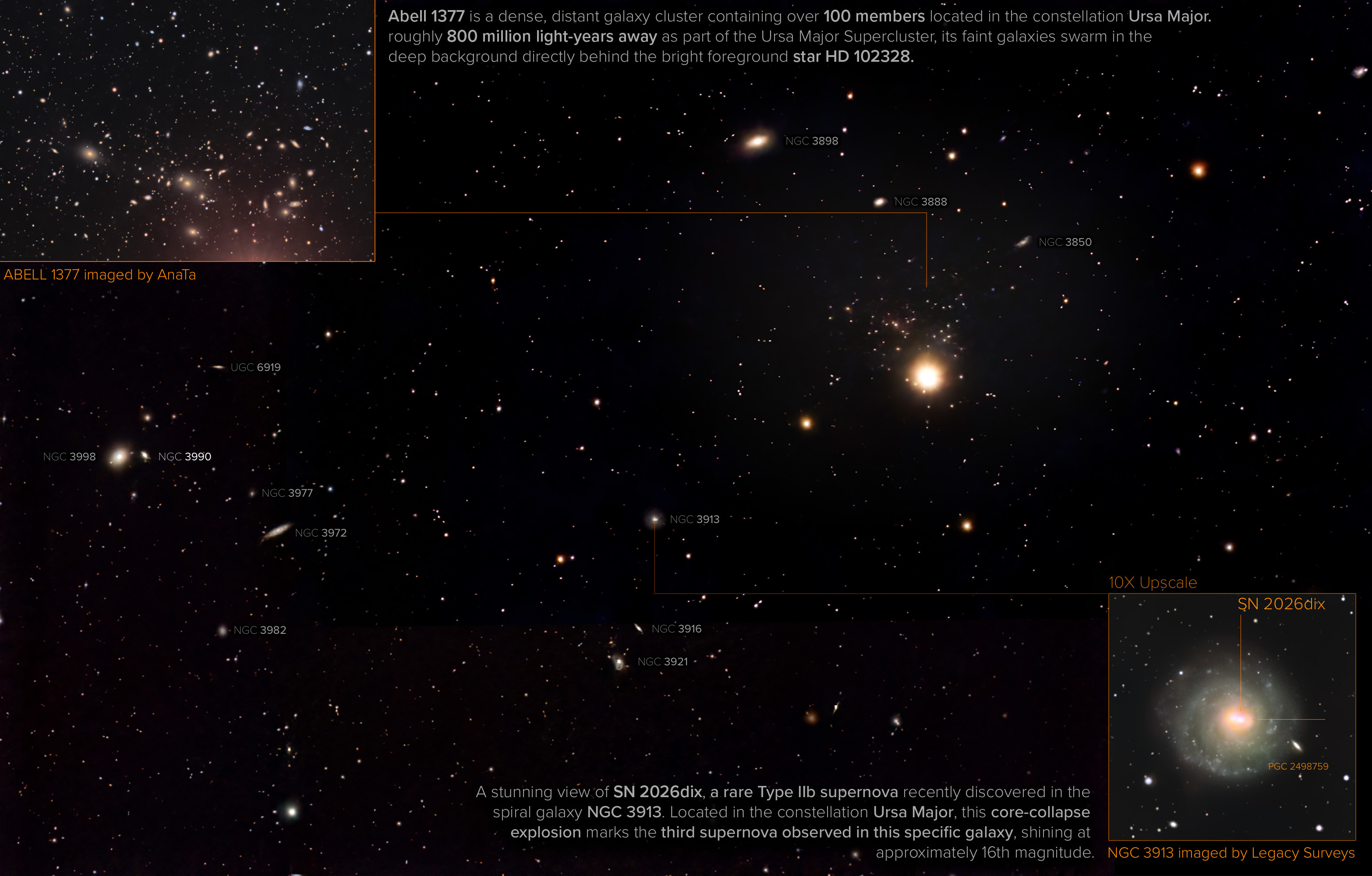
What gives this deep-field composition even more depth is the mind-bending juxtaposition of cosmic distance scales. The primary structure at the center of this field is the NGC 3898 Group (LGG 250), a bound local group located within the broader Ursa Major cloud. Its dominant namesake prototype spiral galaxy, NGC 3898, sits roughly 63 to 72 million light-years away, with its true bound companion, the barred spiral NGC 3850, at a similar distance of 60 to 65 million light-years.
In the near foreground, the face-on spiral NGC 3913 (just lower left of center) sits much closer to us at roughly 27 to 54 million light-years away, acting as an independent foreground galaxy simply drifting through our direct line of sight. This foreground galaxy currently hosts a spectacular cosmic event: SN 2026dix, a rare Type IIb supernova. Blazing away at roughly 16th magnitude, the photons from the SN 2026dix stellar explosion began their journey roughly 40 million years ago. They arrive on our sensor alongside the faint, ancient red glow of Abell 1377’s core members, whose light began its journey when complex life on Earth was just starting to evolve 800 million years ago.
What a treat of cosmic depth, capturing both a “nearer” stellar death and the macro-structure of the ancient universe in a single field of view.
Finally, the deep background interloper NGC 3888—historically lumped into the NGC 3898 Group—actually belongs to a different structure, the NGC 3780 Group (LGG 247). It is located roughly 120 to 130 million light-years away, making it a more distant background galaxy, nearly twice as far as the NGC 3898 core.
One Billion Light Year Limit?
GST22: Abell 2065 & The Corona Borealis Supercluster
Distance: 1 Billion Light-Years
Constellation: Corona Borealis
Classification: Abell Richness Class 3, Bautz-Morgan Class III
Leaving the borders of Ursa Major behind, our final target takes us to the crown of the northern sky to face one of the most massive, gravitationally bound superstructures known to science: the Corona Borealis Supercluster. At the heart of this cosmic metropolis lies its crown jewel, Abell 2065. This ultra-dense hive packs over 400 galaxies into a patch of sky no larger than a full moon, glowing faintly near 16th magnitude.
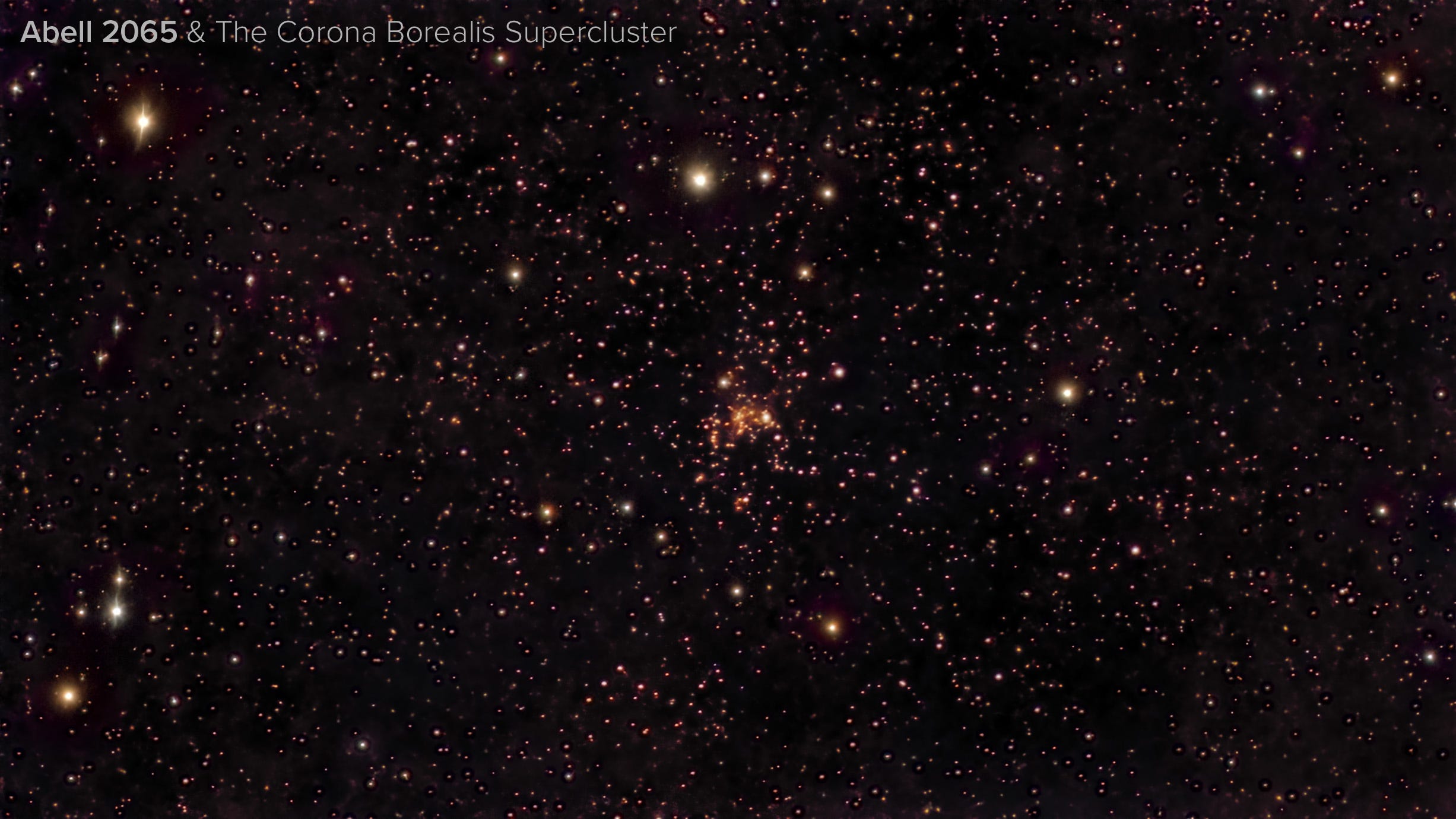
When we gather these ancient photons, we peer across a billion years of lookback time. The light hitting our sensor began its journey during Earth’s Proterozoic Eon, when our planet was dominated entirely by simple, single-celled organisms.
What makes this final mini full-frame truly profound is the revelation brought forward by careful post-processing. By systematically shrinking and dimming the foreground stars in Photoshop, the blinding glare of our own galaxy was stripped away. This exposure reveals a spectacular, obvious radiating spoke pattern stretching across the deep field. With the stars minimized, thousands of ultra-faint, reddish-orange galaxies pop into view, branching outward from the dense central core like cosmic highways.
Historically, resolving the intricate, web-like architecture of an Abell galaxy cluster required an elite, heavy-duty observatory setup. Yet, this magnificent structure was harvested by our portable DWARF mini smart scope. Setups like this and the D3 are completely redefining amateur limits—proving we can push past the billion-light-year glass ceiling and map the absolute abyssal depths of the universe straight from our backyards.
How deep can you push your sensor?
If you are ready to smash through traditional hardware limits and map the deep universe straight from your backyard, join our community of deep-sky hunters.
Click the button below to subscribe to our free Substack newsletter, where you will get advanced smart scope guides, deep-sky target alerts, and astrophotography tips delivered straight to your inbox.
Want to push your processing even further? Choose a paid subscription to support our work and unlock exclusive access to our DATA CLUB. Members get premium DWARF data packs along with advanced, step-by-step Siril and Photoshop workflows to help you extract every hidden photon from the background noise.