

Winter Challenge: The First Sweep & The Wildcards Reveal!
Target two - The California Nebula, Wildcards, and NEW PRIZES announced, and FAQs from our challengers, the inside scoop

Clear skies, everyone! It’s been an incredible start to the DwarfVision Deep Sky Winter Challenge. In just 12 days, we have seen 12 contestants join the hunt, submitting a staggering 62 captures. The level of enthusiasm and the quality of the images coming out of our community is nothing short of stellar.
DwarfVision Spotlight: Target 2 – The California Nebula (NGC 1499)
For our second deep-dive of the Winter Challenge, we are looking at one of the most iconic winter showpieces: the California Nebula. This massive, glowing cloud of gas is a favorite for a reason—its resemblance to the Golden State is uncanny, and it provides a perfect test for your DWARF’s imaging capabilities.
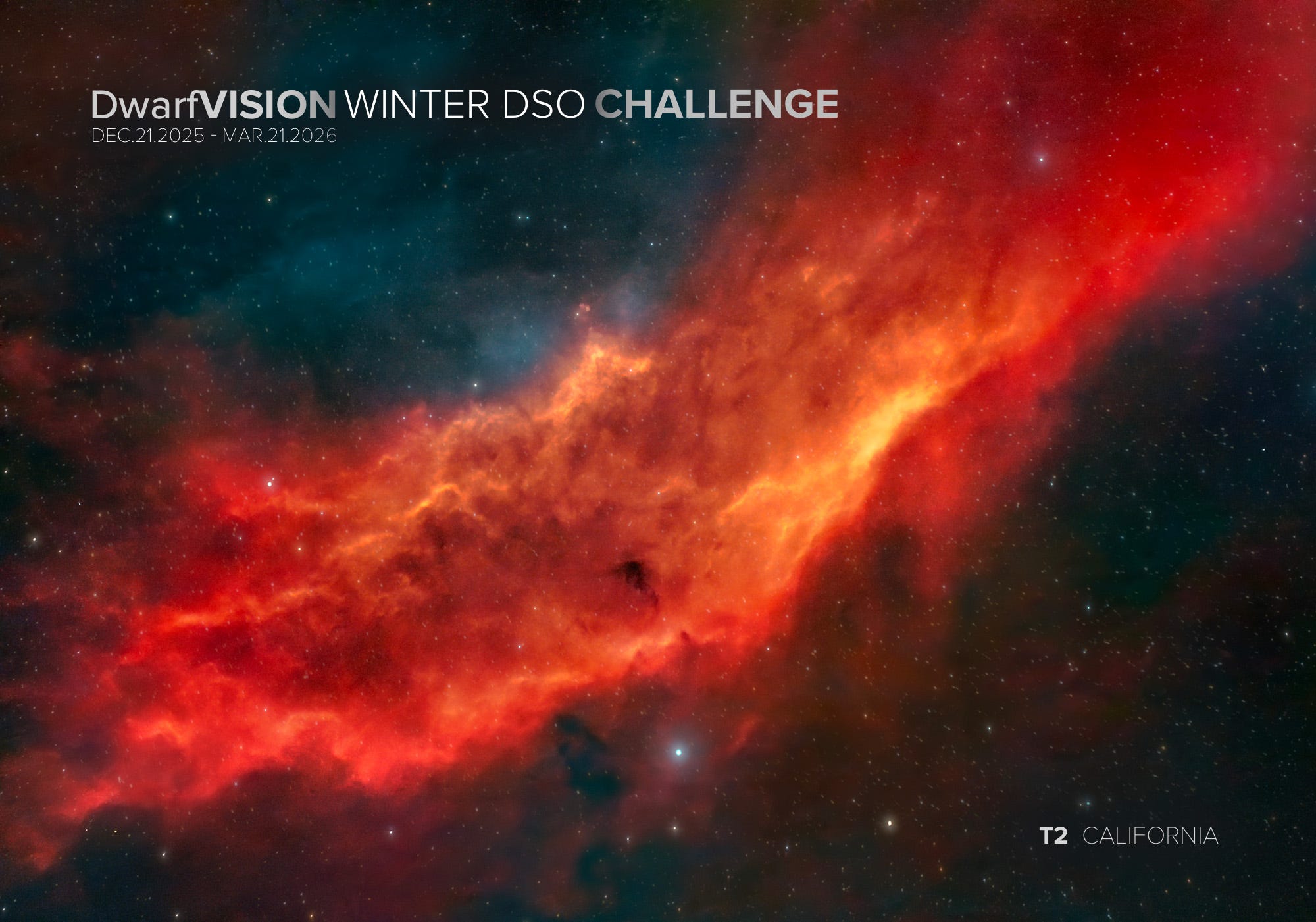
The Target: A Galactic Giant
Type: Emission Nebula.
Location: Constellation Perseus.
Distance: Approximately 1,000 to 1,500 light-years away.
Size: Elongated and massive, spanning about 2.5° across the sky (roughly 60 light-years wide).
The Engine: The nebula is illuminated by the intense radiation of Xi Persei (also known as Menkib), a hot blue-giant star that is over 12,000 times brighter than our sun.
Why It’s a Challenge
The California Nebula has a low surface brightness, meaning that while it is large, its light is spread out thinly. This makes it notoriously difficult to see with the naked eye or even through a traditional eyepiece. Success requires long integration times and the right filters to pull that signature red hydrogen glow out of the background noise.
The California Nebula on Stellarium:

Pro Tip: For those of us in the north shoot this one around 10:30PM - 1:30AM when its orientation in the sky fits long ways on your Dwarfs sensor!
Don’t miss a challenge update, subscribe for free and get the latest right to your inbox.
Now back to the challenge!
The Leaderboard: A Record-Breaking Start
We have a major announcement to kick off our first update: Michael Sullivan has officially swept the first set of 10 DSOs in just three days!. By running two scopes side-by-side, Michael demonstrated incredible efficiency and dedication to claim the first sweep prize of the contest.
The official leaderboard:

Prizes & Rewards
Because the start has been so explosive, DWARFLAB is adding a brand-new prize to the list!
NEW: The Grand Sweep: Any participant who successfully sweeps all 30 DSOs will receive a DWARFLAB Baseball cap and stickers.
Target Completion: Complete a set of 10 DSOs to earn a DwarfVision Merch Pack (Exclusive cap and sticker).
Community Choice: The Facebook community will vote on their favorite submission; the winner gets a DWARFLAB Hoodie.
The Set Champion: Our judges will select three standout entries for a community vote. The winner receives a $50 DWARFLAB Voucher.
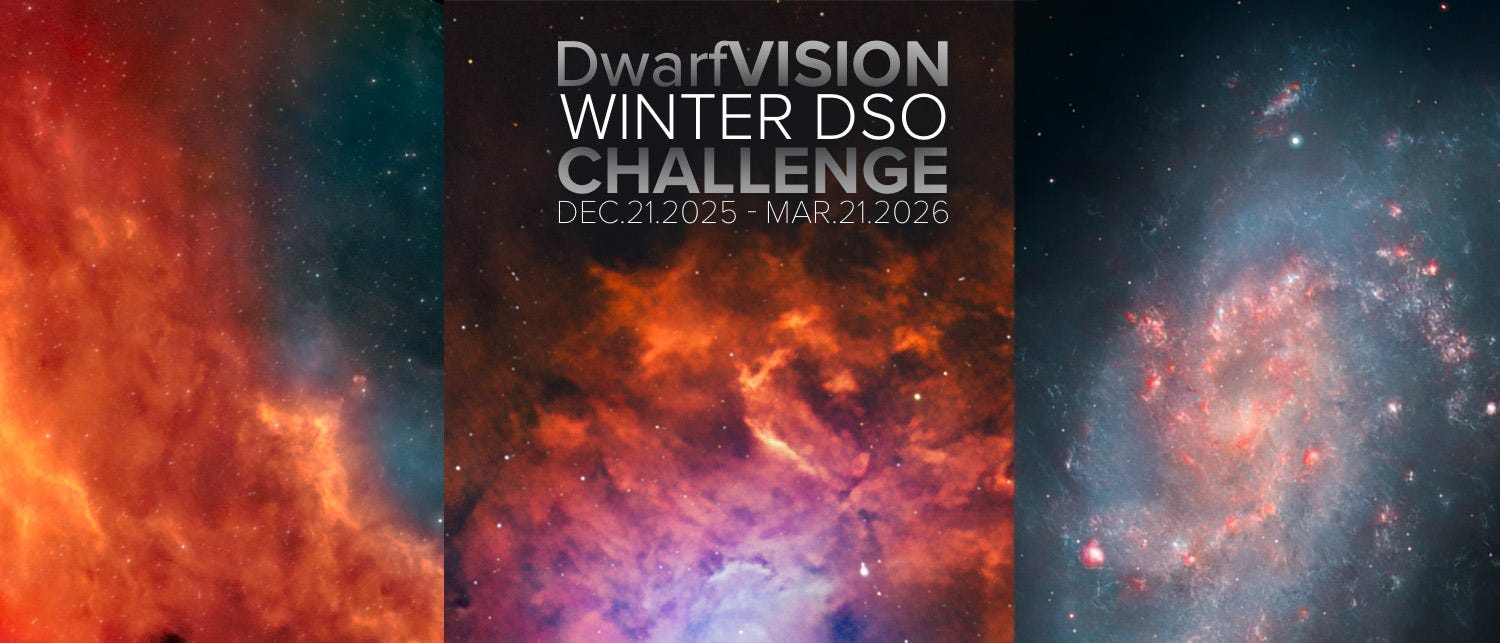
The New Year’s Reveal: The Wildcards
To help you on your journey—especially when targets are too far north or south—we are introducing Wildcards. These can be exchanged for any of the main 30 DSOs, even toward sweep prizes!
Northern Wild Cards
the Double Cluster: NGC 884 & 869 - Const: Perseus, Showpiece DSO
Polarissima Cluster & IFN: (Interstellar Flux Nebula) NGC 188 - Const: Cepheus, Spectre DSO
Embryo Nebula: NGC 1333 - Const: Perseus, Echoes DSO
Southern Wild Cards
Carina Nebula: NGC 3372 - Const: Carina Nebula, Showpiece DSO
Large Magellanic Cloud: The Tarantula Nebula (NGC 2070) - Const: Dorado, Showpiece DSO
The Squid Galaxy: M77- Const. Cetus, Spectre DSO
#DwarfVisionWinterChallenge: Community FAQ
I. Challenge Rules & “Wild Cards”
Q: “What’s a ‘Wild Card’ entry for the challenge?”
Duncan Pond Answers: This season’s challenge features a flexible Wild Card system. There are 3 North and 3 South Wild Cards available. You can use these to replace any of the 30 DSOs on the main list. This ensures everyone—regardless of their hemisphere—can hit the 30-target milestone and stay eligible for all sweep prizes.
The Strategy: We are providing the main set of 30 DSOs in three sets of 10. The Wild Cards will be announced on New Year’s Day, allowing you to fill any gaps in your list from the first three sets.
II. Technical “Pro Moves” & Target Tips
The “Tadpole” Pair: Be aware that IC 410 and NGC 1893 are often imaged together. If the DWARFLAB app only lists one in the GoTo, the other is likely already in the same frame.
The “Trifid” Confusion: Don’t get mixed up! Ensure you are targeting the Northern Trifid (NGC 1579) in Perseus. This is a winter gem, unlike the standard Trifid (M20), which is a summer target.
Filter Stacking in Cities: For those in Bortle 9 areas, the “pro move” is stacking an IR Pass with a Multiband filter. This specific combo is what allowed users like Karl to extract crisp detail from the Northern Trifid and Casper the Friendly Ghost nebula despite heavy light pollution.
III. The Community Asks, The Community Answers
Q: “How do I get those 60-second exposures I see in the challenge posts?”
Chayiana & Michael Answer: You need to use EQ Mode. It is the single best resource for the Dwarf 3 and Mini to align the telescope for 60-second exposures. This is how we are getting those deep, noise-free images for our challenge entries.
Tutorial Recommendation: Dwarf 3 and Mini EQ Mode Tutorial
Q: “Is it safe to run my scope for 7+ hours in the freezing cold?”
Chayiana Morgan Answers: Yes! My Mini sensor dropped to 2–3°C and ran for 7 hours straight without dropping a single frame. The hardware is resilient, just keep an eye on your external power source!
Q: “My image is watermarked with the wrong name—am I in trouble?”
Ujjwal Datta Answers: Not at all. Stellar Studio sometimes uses neighboring catalog IDs (like IC 447 for the Christmas Tree Cluster). As long as the target is visually correct, your entry counts!
Clear Skies, and happy shooting! - Duncan
